
The Siesta
Category:
Created:
1894
Likes:
0
Dimensions:
Download:
New users get 4 free credits. 2K costs 1 credit; 4K and Ultra HD are priced by resolution. Public domain artworks can be used commercially.
Dominant colors
Public domain download summary
This artwork is provided as a public domain image resource. The 2K file costs 1 credit for everyday creative work, while 4K and Ultra HD files are priced by resolution.
Art Appreciation
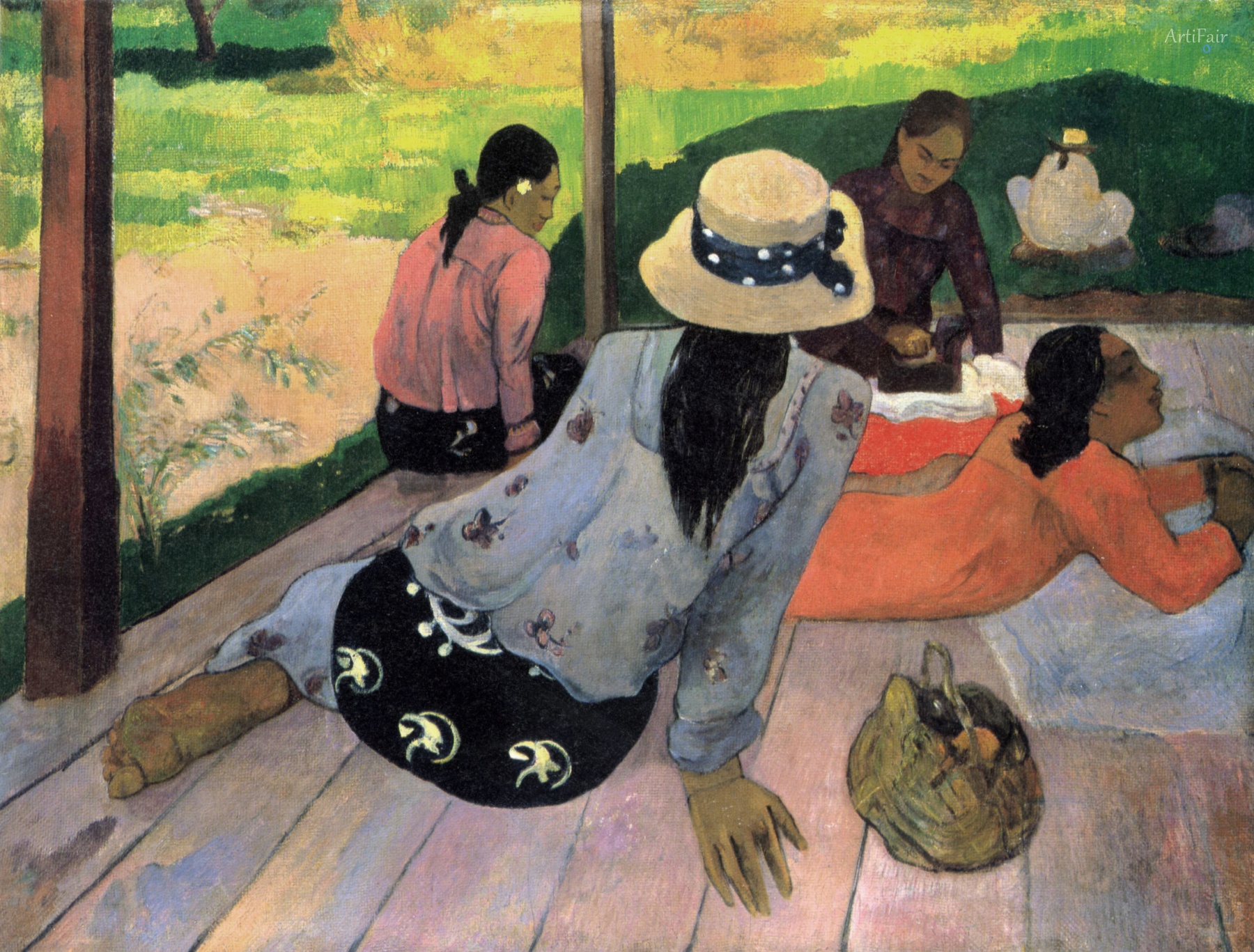
The Siesta is an oil on canvas by Paul Gauguin, painted about 1892–94 in connection with his first extended stay in Tahiti; it measures 88.9 × 116.2 cm and is in the Metropolitan Museum of Art, New York, part of the Walter H. and Leonore Annenberg Collection.
Gauguin first went to Tahiti in 1891 and left the island in 1893. The Met notes that it is not known whether he painted this picture shortly before his departure or soon after his return to Paris. Unlike many of his Tahitian canvases, it carries no complex religious or mythological meaning. It is a kind of Polynesian genre scene, and the museum observes that the unaffected grace and communal ease of Tahitian women impressed Gauguin enormously.
A group of women has taken refuge from the hot afternoon sun in the shade of a roughly built wooden porch. They wear the so-called missionary dresses that were regularly imported from England. One sits at the left edge of the porch looking out, another, nearest to us, faces away under a broad straw hat, a third bends over a white cloth, and a fourth lies stretched on her front at the right; one of the women is said to be doing her ironing. Beyond the porch a bright green lawn rises towards the trees, cut by the vertical posts of the roof.
Although the subject comes from everyday life, Gauguin worked on the canvas over a long period and made numerous changes. The Met records that the skirt of the foreground woman was originally bright red, that a dog once occupied the place now taken by the basket at lower right, and that the woman at the left edge of the porch was first placed further to the left. The painting was given to the museum by Walter H. and Leonore Annenberg in 1993, with Walter Annenberg's bequest completing the gift in 2002.