
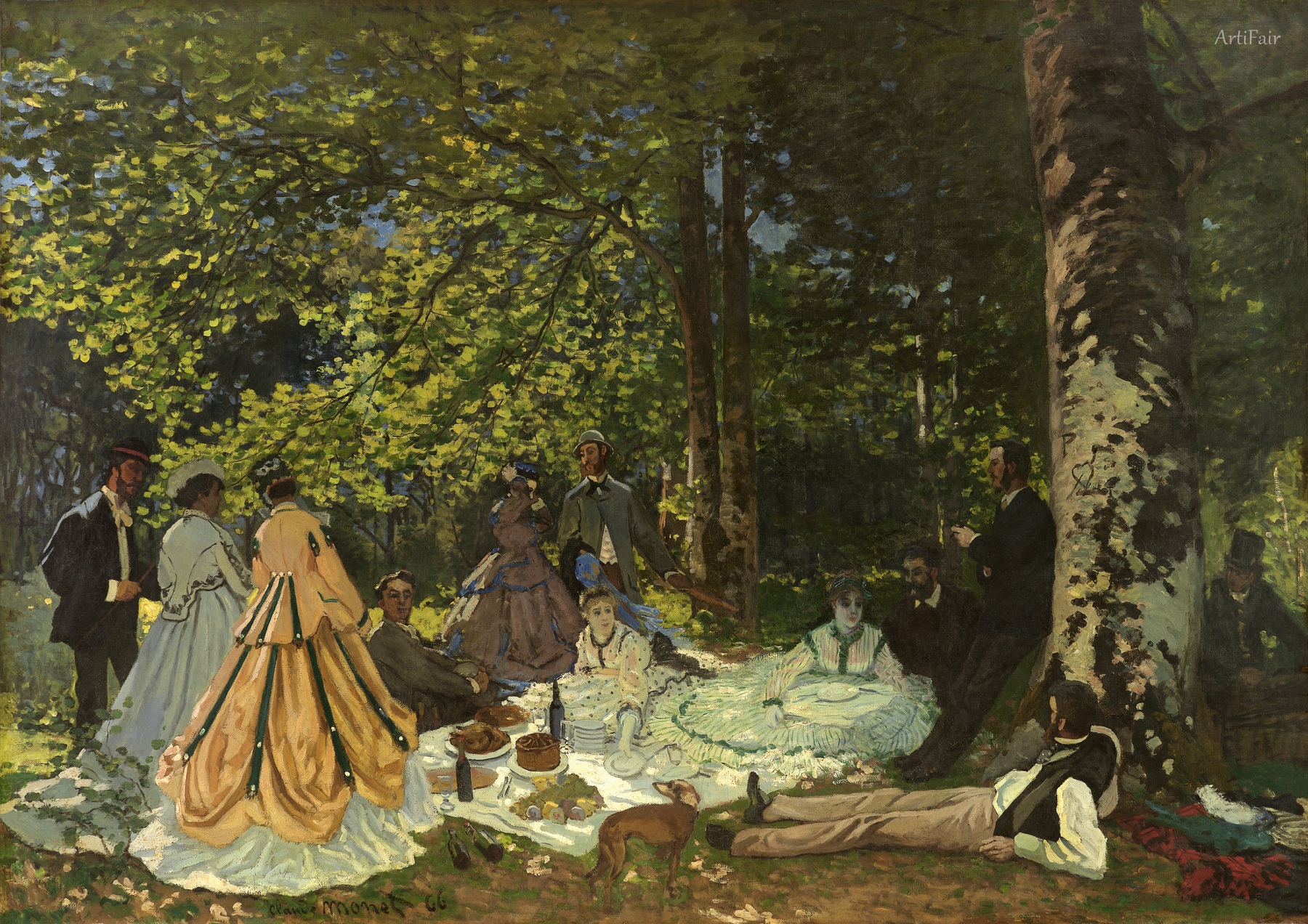
Luncheon on the Grass
Category:
Created:
1866
Likes:
1
Dimensions:
Download:
New users get 4 free credits. 2K costs 1 credit; 4K and Ultra HD are priced by resolution. Public domain artworks can be used commercially.
Dominant colors
Public domain download summary
This artwork is provided as a public domain image resource. The 2K file costs 1 credit for everyday creative work, while 4K and Ultra HD files are priced by resolution.
Art Appreciation
Luncheon on the Grass (Le Déjeuner sur l'herbe) is an oil on canvas by Claude Monet, signed and dated 1866, the smaller, complete version of his abandoned picnic composition; it is in the Pushkin State Museum of Fine Arts, Moscow.
Monet conceived the project on painting trips to the Forest of Fontainebleau near Chailly in 1865 and planned a canvas more than six metres wide for the Salon of 1866, partly as a response to Édouard Manet's Luncheon on the Grass of 1863. He underestimated the difficulty of transferring his studies to life size and, dissatisfied, withdrew the picture. In 1878 he left the unfinished canvas with his landlord at Argenteuil as security for unpaid rent; when he recovered it in 1884 it had been damaged by damp, and he cut it up. Two fragments, the left and central parts, are now in the Musée d'Orsay, Paris.
The Moscow canvas, 130 by 181 cm, is the only record of the whole design, with twelve fashionably dressed men and women around a white cloth spread with food beneath sunlit trees. Frédéric Bazille, who went with Monet to Chailly, posed for most of the men, and Camille Doncieux for the women; Gustave Courbet also appears. Rather than everyday detail, Monet concentrated on sunlight playing over the women's dresses and the tablecloth. It was long regarded as a preparatory sketch, but the Pushkin Museum now considers it more likely a later repetition of the large painting, citing its careful detail and the signature at lower left.
The picture belonged for a time to the opera singer Jean-Baptiste Faure and may have been shown at Durand-Ruel's Monet exhibition in 1900. Sergei Shchukin bought it through the dealer Paul Cassirer, in 1904 according to Russian sources. Nationalised in 1918, it went to the State Museum of New Western Art and in 1948 to the Pushkin Museum.