
The Yellow House ('The Street')
Category:
Created:
1888
Likes:
0
Dimensions:
Download:
New users get 4 free credits. 2K costs 1 credit; 4K and Ultra HD are priced by resolution. Public domain artworks can be used commercially.
Dominant colors
Public domain download summary
This artwork is provided as a public domain image resource. The 2K file costs 1 credit for everyday creative work, while 4K and Ultra HD files are priced by resolution.
Art Appreciation
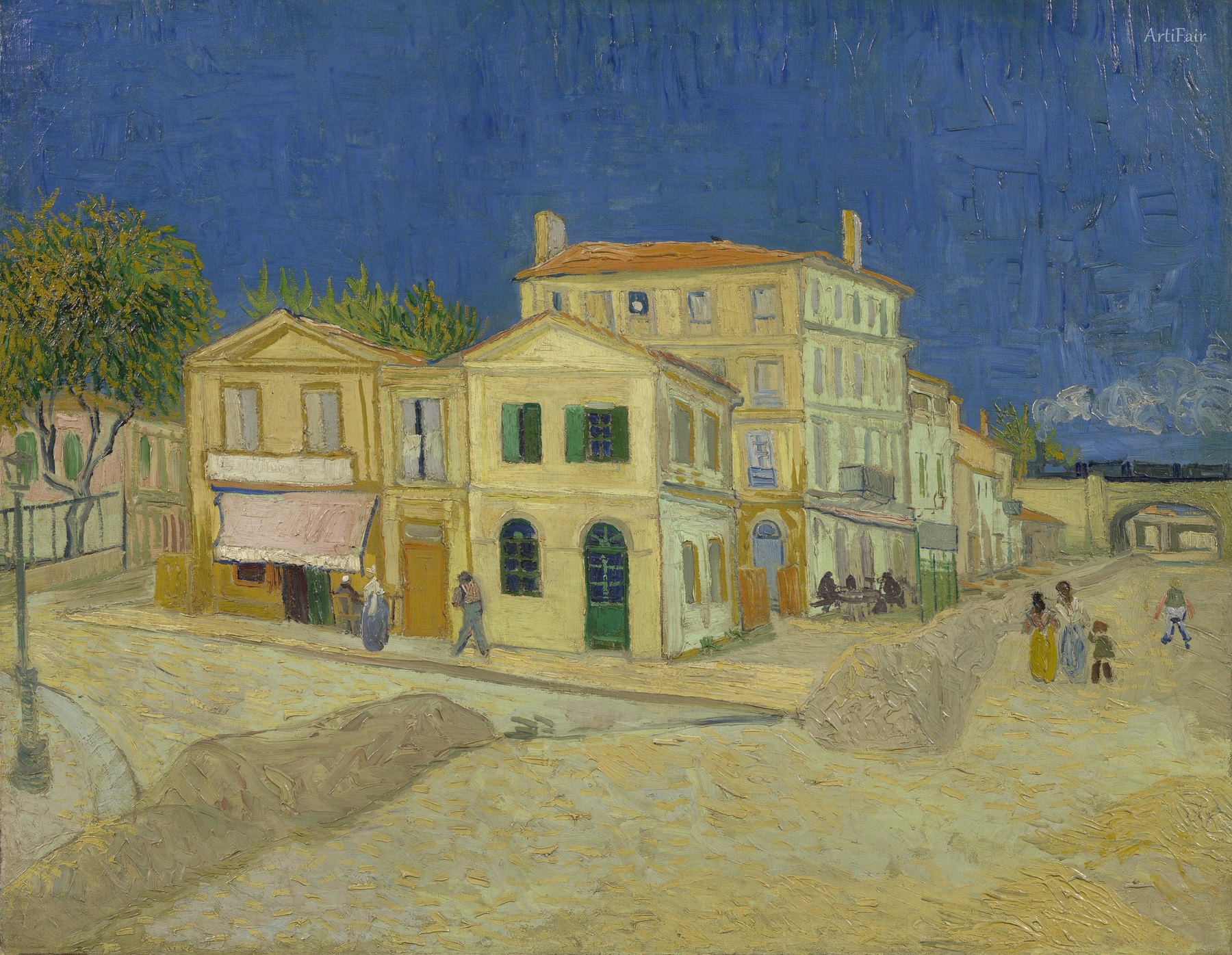
The Yellow House, which Van Gogh himself called The Street, is an oil painting on canvas by Vincent van Gogh, made in Arles in September 1888 and now in the Van Gogh Museum, Amsterdam (Vincent van Gogh Foundation). It measures 72 × 91.5 cm.
On 1 May 1888 Van Gogh rented four rooms in the right wing of 2 Place Lamartine, a yellow corner building: two large rooms on the ground floor became his studio and kitchen, and two smaller ones upstairs faced the square. He hoped to turn it into an artists' house where like-minded painters could live and work together. The window nearest the corner with both shutters open belongs to the guest room, where Paul Gauguin stayed for nine weeks from late October 1888; behind the next, nearly closed shutters is Van Gogh's bedroom.
Sending Theo a sketch, he described the house and its setting under a sulphur sun and a pure cobalt sky, admitting the subject was hard but that this was exactly why he wanted to conquer it, because the yellow houses in the sun and the incomparable freshness of the blue were tremendous. The picture maps his daily life: he ate in the restaurant on the left, run by the widow Venissac, who was also his landlady, and his friend the postman Joseph Roulin lived just beyond the second railway bridge. The night café he had just painted lay just outside the picture. His friend Paul-Eugène Milliet found the subject horrible, but Van Gogh cited Zola and Flaubert, who had made literature out of ordinary streets. He first called it The House and its Surroundings and later The Street, a nod to Jean-François Raffaëlli's Paris street scenes published in Le Figaro.
The painting never left the artist's family and passed to the Vincent van Gogh Foundation in 1962. The house itself was badly damaged in an Allied bombing raid on 25 June 1944 and later demolished; a plaque marks the site.