
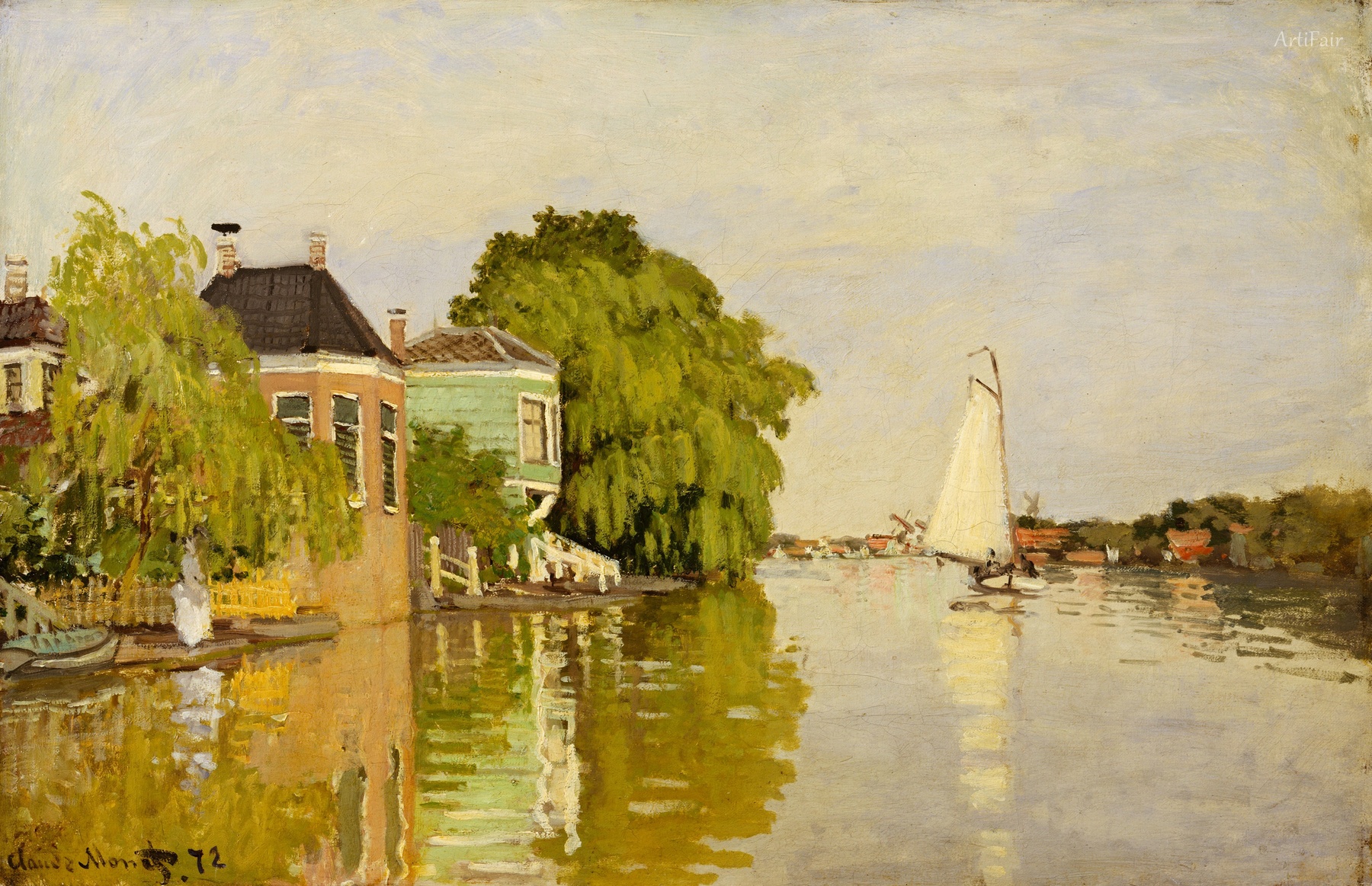
Houses on the Achterzaan
Category:
Created:
1872
Likes:
2
Dimensions:
Download:
New users get 4 free credits. 2K costs 1 credit; 4K and Ultra HD are priced by resolution. Public domain artworks can be used commercially.
Dominant colors
Public domain download summary
This artwork is provided as a public domain image resource. The 2K file costs 1 credit for everyday creative work, while 4K and Ultra HD files are priced by resolution.
Art Appreciation
Houses on the Achterzaan is an oil-on-canvas landscape painted by Claude Monet in 1871 in Zaandam, the Netherlands; it belongs to the Robert Lehman Collection of the Metropolitan Museum of Art, New York (1975.1.196).
Monet married Camille Doncieux in June 1870, shortly before the Franco-Prussian War, and the family sat out the conflict in London. On the advice of the Barbizon painter Charles-François Daubigny, who strongly recommended the Achterzaan river, Monet travelled on to the Netherlands in 1871 and spent about four months in Zaandam before returning to France and settling in Argenteuil later that year. In a letter to Camille Pissarro he called Zaandam a superb place for painting, full of windmills and charming boats.
The picture shows garden houses on the west bank of the Achterzaan, seen from the dam in the Zaan looking northwest. A weeping willow and a row of brick and green-painted houses line the left bank, their reflections stretched across the still water, while a white-sailed boat and distant windmills punctuate the right side under a wide, pale sky. The Met points to the limited range of greens and the muted, cool colours, which it links to Monet's interest in Barbizon painting at this early stage of his career, and to the way he rendered the hazy air and light-flecked water. The canvas measures 44.1 by 67.3 cm and is signed and dated at lower left Claude Monet 72, even though it is dated to the 1871 stay; it is number 186 in Daniel Wildenstein's catalogue raisonné.
Monet's Dutch landscapes were well received by his colleagues, Daubigny above all, whose own studies of light and water share their concerns. The painting entered the Metropolitan Museum in 1975 with the collection of Robert Lehman and hangs in the Lehman galleries.