
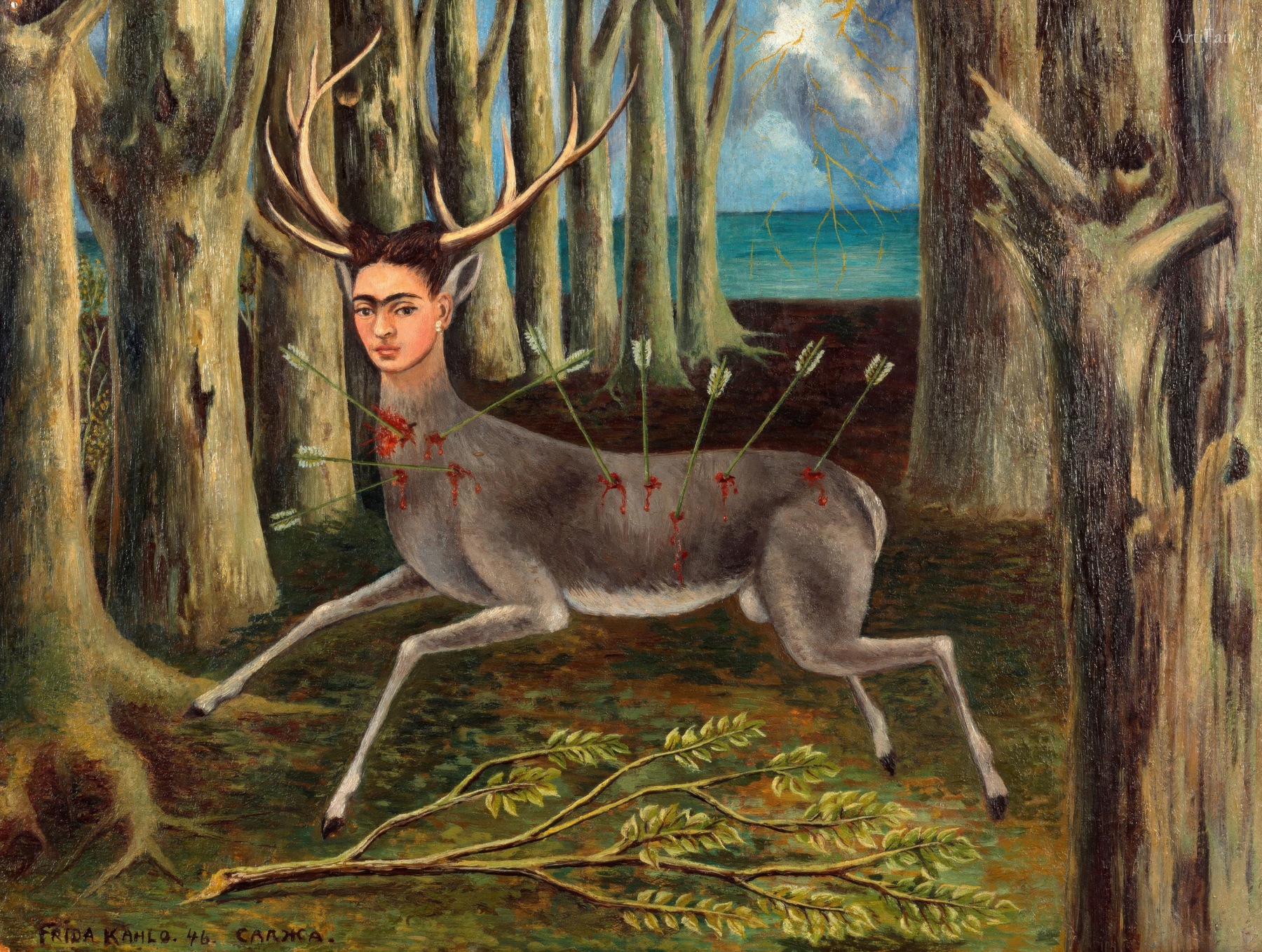
The Wounded Deer
Category:
Created:
1946
Likes:
0
Dimensions:
Download:
New users get 4 free credits. 2K costs 1 credit; 4K and Ultra HD are priced by resolution. Public domain artworks can be used commercially.
Dominant colors
Public domain download summary
This artwork is provided as a public domain image resource. The 2K file costs 1 credit for everyday creative work, while 4K and Ultra HD files are priced by resolution.
Art Appreciation
The Wounded Deer (El venado herido), also called The Little Deer, is a 1946 oil-on-masonite painting by the Mexican artist Frida Kahlo; just 22.4 by 30 cm, it belongs to a private collection.
Kahlo made it toward the end of her life, as her health declined. In 1946 she underwent a spinal operation in New York that failed to relieve her pain, and she painted this small picture after returning to Mexico. On 3 May 1946 she gave it to her friends Arcady and Lina Boytler as a wedding gift, together with a verse calling the painted deer her own portrait. Around the same time she drew a young deer in her diary, thought to have been inspired by her pet deer Granizo.
In the painting her head, crowned with the antlers of a stag, sits on the body of a young deer running through a wood, its front leg raised as if stumbling; nine arrows pierce the animal's body and blood flows from the wounds. A broken branch lies prominently in the foreground — in Mexican custom a broken branch is placed on a grave — while through the trees at the right a bright stretch of water is lit by a bolt of lightning. Her face looks out calmly, showing strength rather than anguish. Next to her signature at the lower left she wrote 'carma' — karma — a word tied to her belief that her misfortunes were destined.
Commentators connect the number nine — the arrows, the trees, the points of the antlers — to the day of her birth in the Aztec calendar, and the deer itself to the pre-Columbian association of the animal with the right foot, the limb that troubled her most. The arrows also evoke the Christian martyr Saint Sebastian, so that pre-Columbian, Eastern and Christian imagery meet in one of her most analyzed self-portraits.