
Poplars
Category:
Created:
1891
Likes:
2
Dimensions:
Download:
New users get 4 free credits. 2K costs 1 credit; 4K and Ultra HD are priced by resolution. Public domain artworks can be used commercially.
Dominant colors
Public domain download summary
This artwork is provided as a public domain image resource. The 2K file costs 1 credit for everyday creative work, while 4K and Ultra HD files are priced by resolution.
Art Appreciation
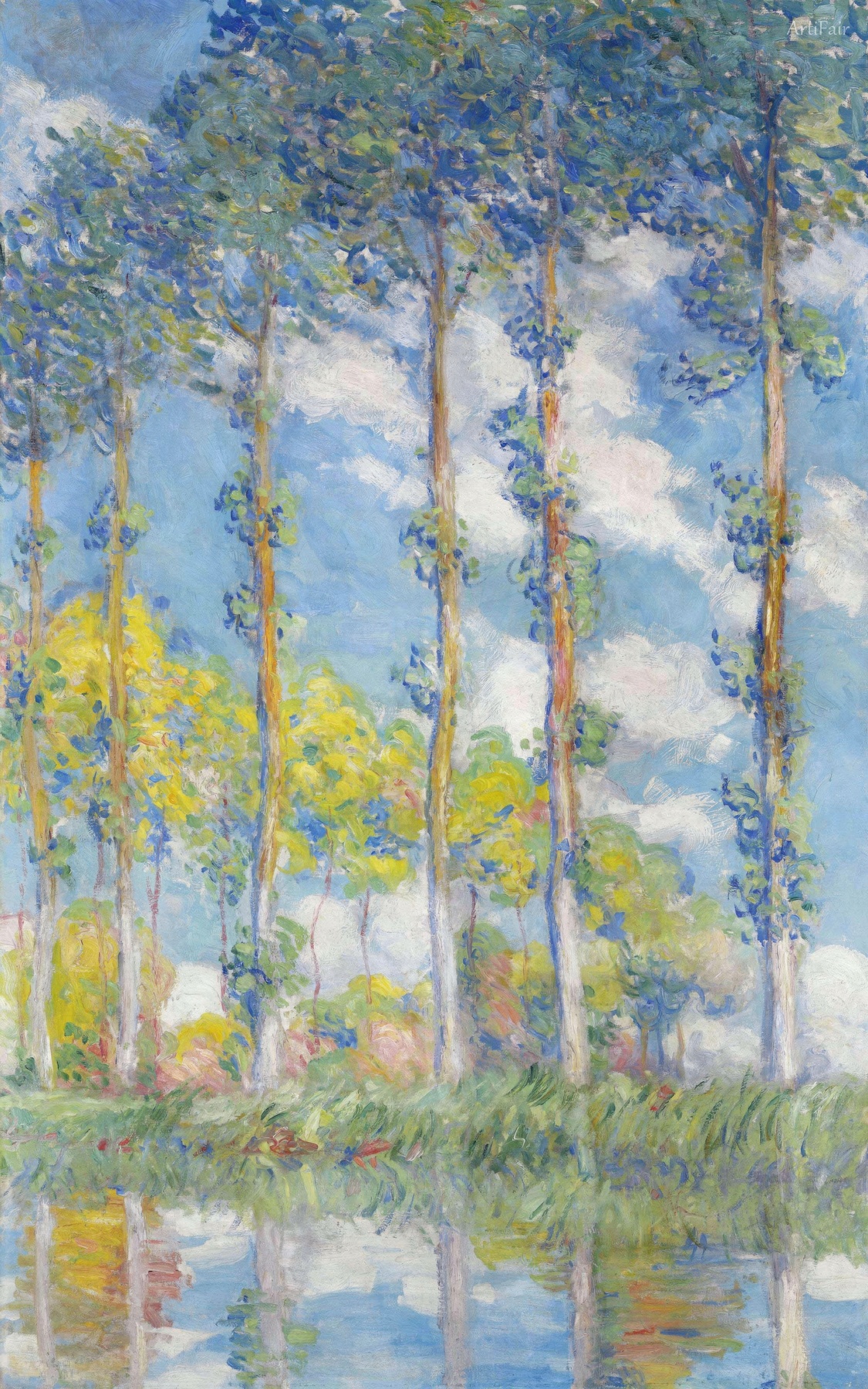
Poplars (Les Peupliers) is an oil on canvas painted by Claude Monet in 1891, one of the views of poplars on the river Epte that make up his Poplars series; this canvas (Wildenstein no. 1301) is in a private collection.
Monet began the poplar campaign in the spring of 1891, before his Wheatstacks had even gone on show at Durand-Ruel's gallery, and it was his only project that summer. The trees stood on communal land near Limetz, about two kilometres upstream from his home at Giverny, along a stretch where the Epte bends twice into an S-curve. When the commune announced that the trees, planted as a cash crop, would be auctioned in early August, Monet failed to persuade the mayor to delay the sale and instead bought them himself with a local timber merchant, who agreed to leave them standing for some months. The low viewpoint suggests that he worked from his floating studio boat moored in the river, although he probably developed the canvases further in the studio.
In eleven of the pictures, including this one, the whole sweep of the poplars along the bank is contained within the frame, rising and falling with the curve of the river; in others he moved closer, reducing the foreground to three cropped trees. Here the scene is painted in warm sunshine, with a blue sky flecked with clouds and bright light on the leaves. Christie's describes it as the largest of the series; it measures 116.2 by 72.2 cm.
In March 1892 fifteen of the Poplars were shown at Durand-Ruel's gallery in an exhibition devoted to the series alone, and the show was a success with critics. This canvas belonged to Dr Georges Viau in Paris, later to A. and R. Ball and Else Sackler in New York, and was sold at Christie's New York in November 2000.