
Woman Holding a Balance
Category:
Created:
1664
Likes:
0
Dimensions:
Download:
New users get 4 free credits. 2K costs 1 credit; 4K and Ultra HD are priced by resolution. Public domain artworks can be used commercially.
Dominant colors
Public domain download summary
This artwork is provided as a public domain image resource. The 2K file costs 1 credit for everyday creative work, while 4K and Ultra HD files are priced by resolution.
Art Appreciation
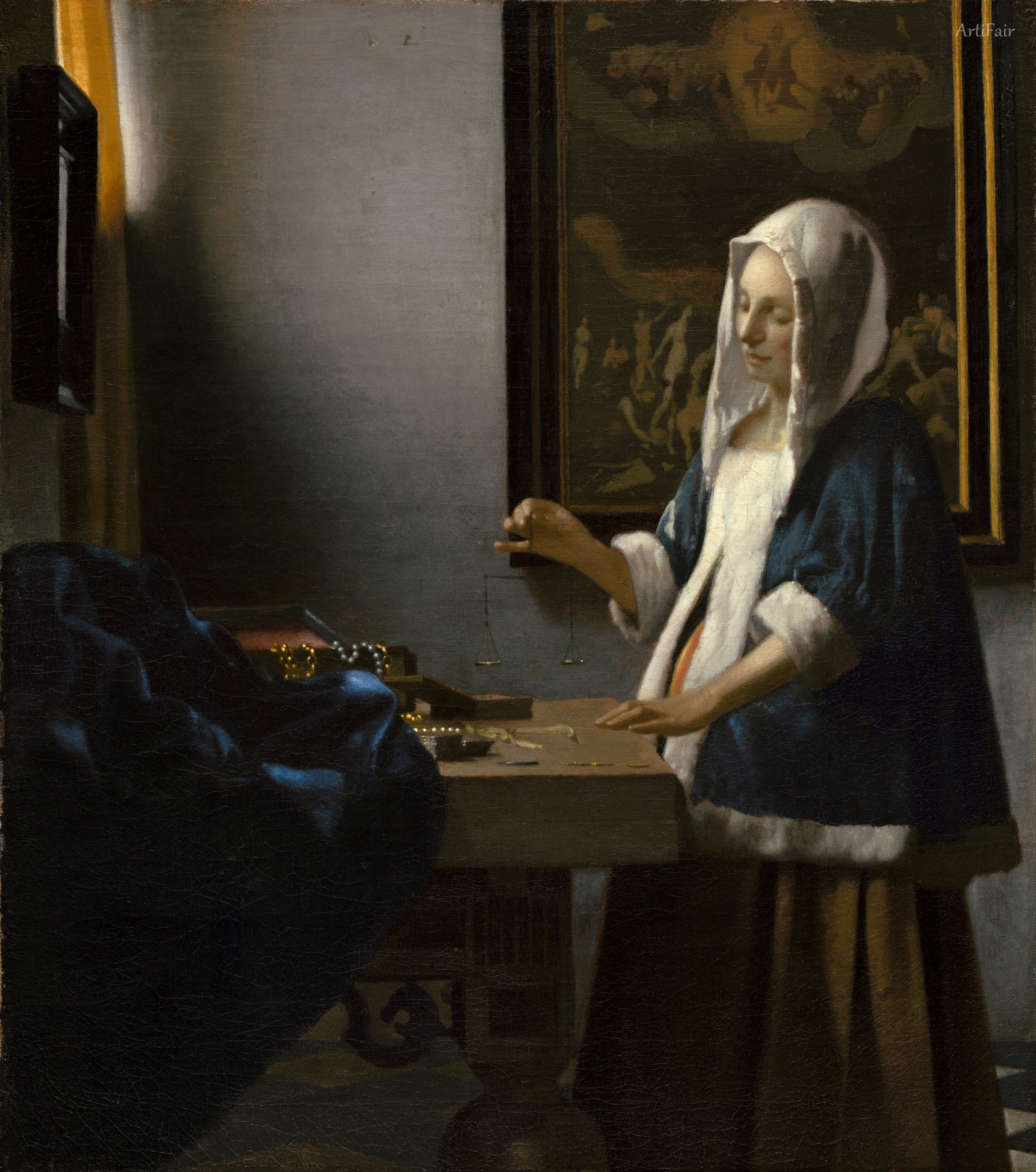
Woman Holding a Balance is an oil painting on canvas by the Dutch Golden Age painter Johannes Vermeer, made around 1662–1665 and now in the National Gallery of Art, Washington, DC, which received it with the Widener bequest in 1942.
The small canvas, 42.5 × 38 cm, shows a young woman in a fur-trimmed blue jacket standing at a table by a window, its light falling through a yellow curtain. She holds a small balance over an open box from which pearls and gold spill; a mirror hangs at left, and on the back wall is a painting of the Last Judgment with Christ raising both arms. For a long time the work was known as Woman Weighing Gold, but microscopic examination showed that the pans of the balance are empty. The painter of the Last Judgment has never been identified; Pieter van Thiel suggested the Flemish artist Jacob de Backer, and Vermeer may have owned the picture or kept it as dealer's stock.
Interpretations differ. Scholars have read the scene as a vanitas, as an image of divine justice, as an aid to religious meditation, or as advice to live a balanced life. John Michael Montias saw the woman, who may be pregnant, as a figure of Mary symbolically weighing unborn souls; Edward Snow argued the picture offers comfort rather than a warning.
At the Amsterdam sale of Jacob Dissius's collection on 16 May 1696 it fetched 155 guilders, more than Officer and Laughing Girl but less than The Milkmaid at 177. In 1826 it was sold in Munich as a work by Gabriel Metsu, later belonged to the Périer family in Paris, and was bought by Peter A. B. Widener in 1911. Technical studies found strips about 5 cm wide added to every side at a much later date; a 1994 treatment removed black overpaint from the frame of the Last Judgment.