
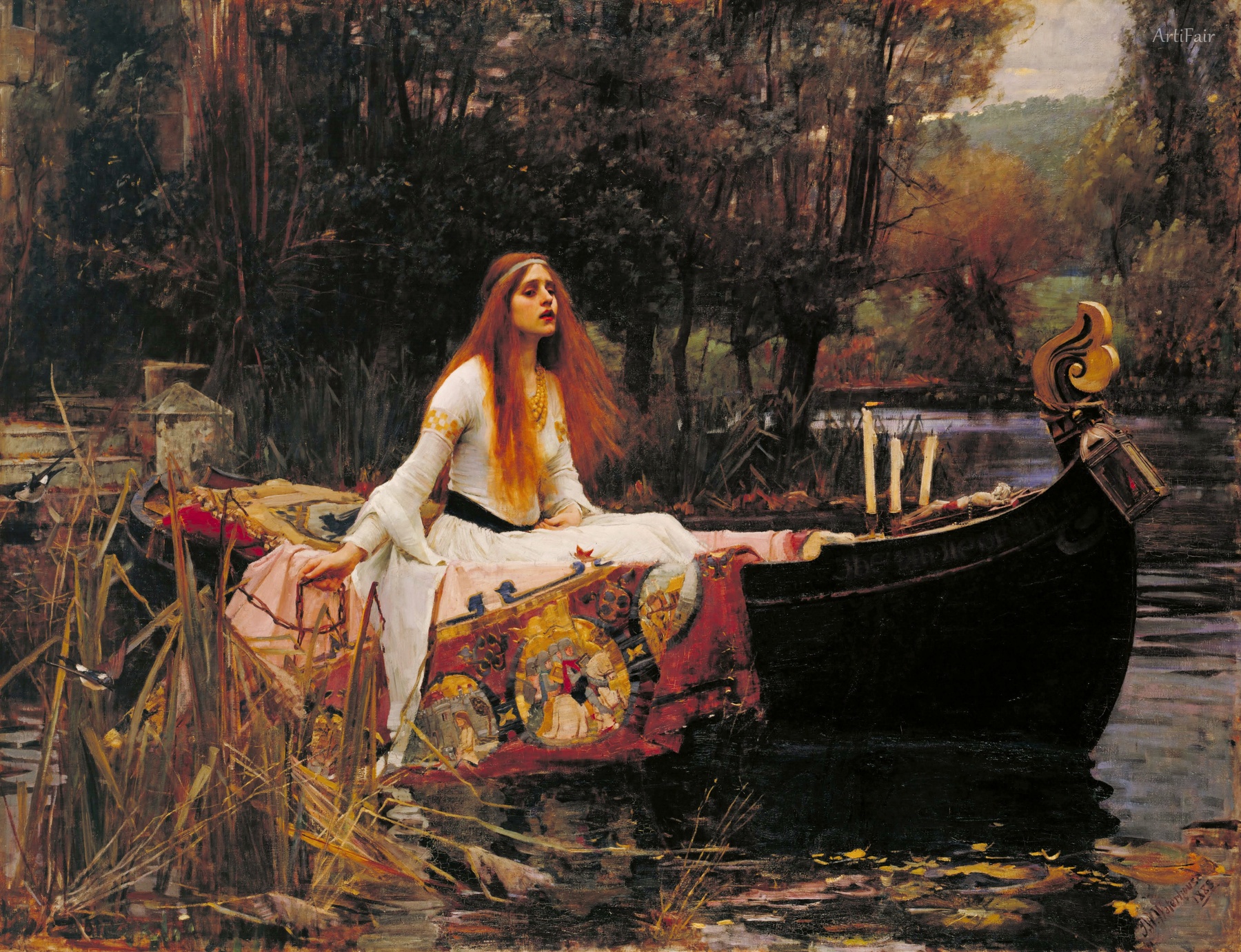
The Lady of Shalott
Category:
Created:
1888
Likes:
3
Dimensions:
Download:
New users get 4 free credits. 2K costs 1 credit; 4K and Ultra HD are priced by resolution. Public domain artworks can be used commercially.
Dominant colors
Public domain download summary
This artwork is provided as a public domain image resource. The 2K file costs 1 credit for everyday creative work, while 4K and Ultra HD files are priced by resolution.
Art Appreciation
The Lady of Shalott is an oil painting on canvas by John William Waterhouse, dated 1888; it was among the original pictures Sir Henry Tate gave to the nation in 1894 and is usually on display at Tate Britain in London.
The picture illustrates the end of Alfred Tennyson's poem 'The Lady of Shalott', first published in 1832. Under a mysterious curse, the Lady lives alone in a tower on the island of Shalott, on a river flowing down to King Arthur's Camelot, and may see the world only as a reflection in a mirror, weaving what she sees into cloth. When the knight Lancelot rides by she looks at him directly, the mirror cracks, and she feels the curse fall upon her. She leaves in a boat, singing her last song as she drifts towards Camelot, but dies before she arrives. Tennyson's figure is loosely based on Elaine of Astolat from Arthurian legend.
Waterhouse shows the moment from part IV of the poem when, at the close of day, she loosens the boat's chain. She sits on the cloth she has woven, gazing towards a crucifix at the prow set before three candles; two have already gone out, a sign that her life is ending, and Tate notes that swallows fly low as the wind lifts her hair. The naturalistic riverbank, with plants that would grow along an English river, comes from a brief period when Waterhouse painted in the open air; the location is not identified, though the family often visited Somerset and Devon. The model is traditionally said to be his wife.
Waterhouse, whose copy of Tennyson's works was filled with pencil sketches, returned to the subject twice: a version of 1894 in Leeds shows the Lady at the moment the curse strikes, and a third followed in 1915. Tennyson's verse had earlier been illustrated by Rossetti, William Holman Hunt and others. The canvas measures 153 by 200 cm.