
Hylas and the Nymphs
Category:
Created:
1896
Likes:
4
Dimensions:
Download:
New users get 4 free credits. 2K costs 1 credit; 4K and Ultra HD are priced by resolution. Public domain artworks can be used commercially.
Dominant colors
Public domain download summary
This artwork is provided as a public domain image resource. The 2K file costs 1 credit for everyday creative work, while 4K and Ultra HD files are priced by resolution.
Art Appreciation
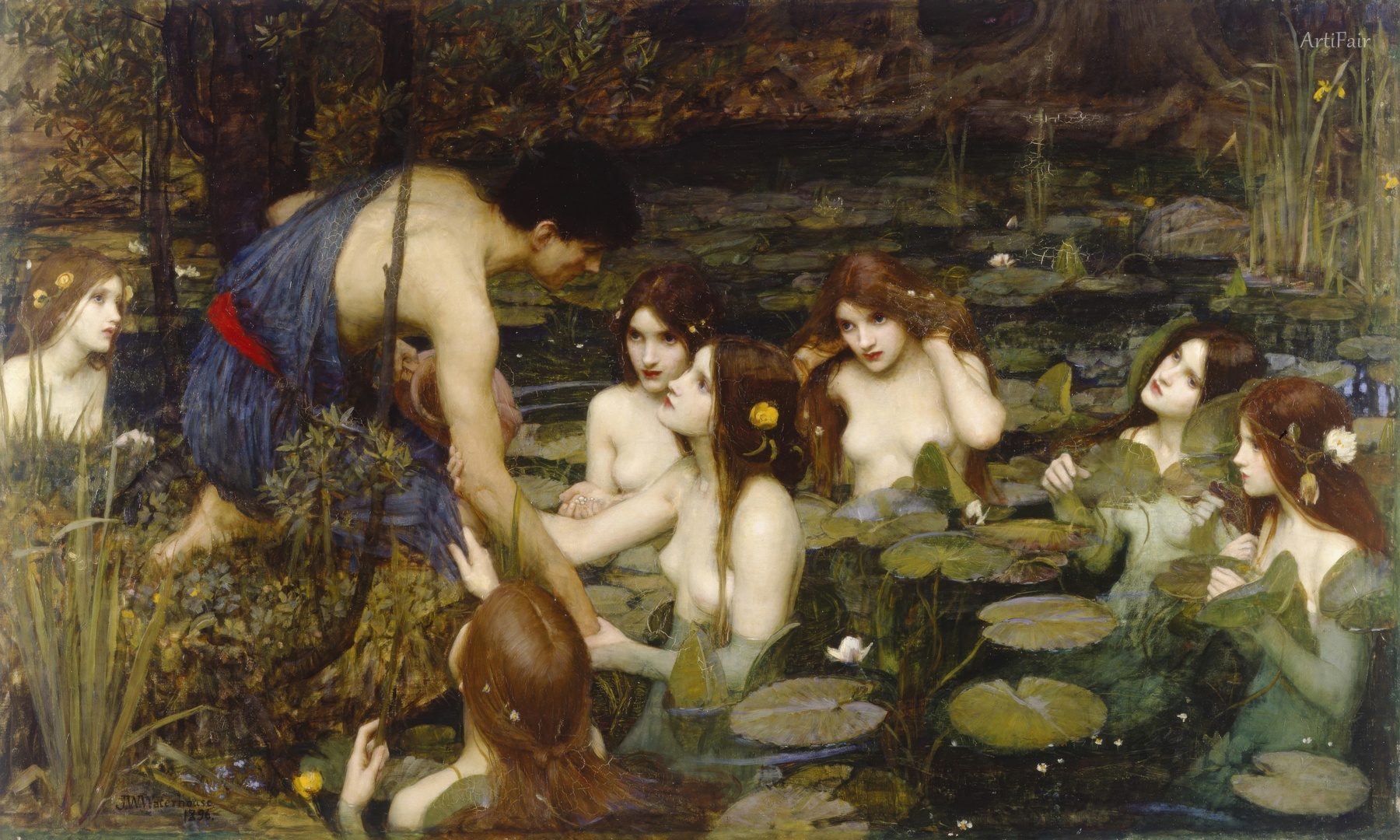
Hylas and the Nymphs is an 1896 oil painting by the English artist John William Waterhouse, held by the Manchester Art Gallery, which acquired it from the painter in the year it was made.
The picture illustrates a moment from the Greek legend of Hylas as told by Ovid and other ancient writers. Hylas, son of King Theiodamas of the Dryopians, became the companion of Hercules after the hero killed his father, and sailed with the Argonauts in search of the Golden Fleece. Sent ashore for fresh water, he reached a pond where water nymphs drew him in, and he was never seen again.
Waterhouse shows Hylas in a blue tunic and red sash, bending with his wide-necked jar toward seven nymphs who rise among the water lilies — an early painted depiction of the yellow waterlily Nuphar lutea. One nymph takes his wrist, another plucks at his tunic, a third offers pearls. His face is in shadow while the nymphs, so alike they may have been modelled on only two sitters, gaze up at him. The raised viewpoint looks straight down at the water, excluding sky and Hercules alike and concentrating the scene on the nymphs' quiet menace. Preparatory sketches survive in the Ashmolean Museum, Oxford.
The painting was exhibited at the Royal Academy Summer Exhibition of 1897. Hylas was a popular subject among Victorian and Edwardian painters — William Etty and Henrietta Rae treated it, and Waterhouse himself had painted the theme in 1893. In 2018 the Manchester Art Gallery briefly removed the canvas to prompt debate about the depiction of women; after a week of strong public reaction it was returned to the wall.