
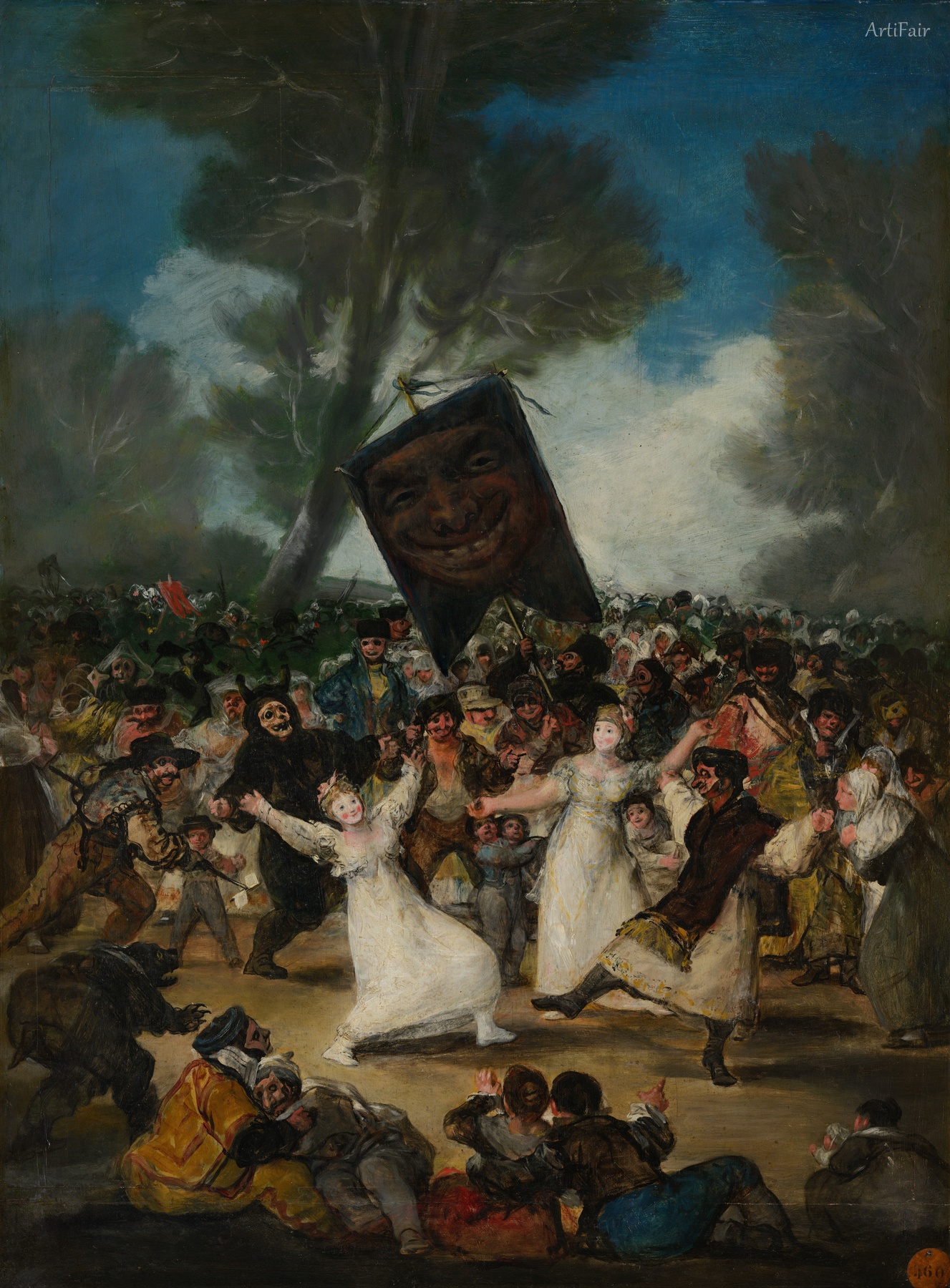
The Burial of the Sardine
Category:
Created:
1812
Likes:
0
Dimensions:
Download:
New users get 4 free credits. 2K costs 1 credit; 4K and Ultra HD are priced by resolution. Public domain artworks can be used commercially.
Dominant colors
Public domain download summary
This artwork is provided as a public domain image resource. The 2K file costs 1 credit for everyday creative work, while 4K and Ultra HD files are priced by resolution.
Art Appreciation
The Burial of the Sardine (El entierro de la sardina) is an oil-on-panel painting by Francisco Goya in the Real Academia de Bellas Artes de San Fernando, Madrid; the Academy dates it to 1808–1812, while other scholars have placed it as late as 1819.
The title, given after Goya's death, refers to the event that closed Madrid's carnival on Ash Wednesday, when masked revellers danced their way to the banks of the Manzanares to bury a sardine. The painting may be the one called Masked Ball in the inventory made at Goya's death. The Academy describes it as a perfect example of a work conceived in complete freedom, for himself or his close friends. It belongs with four other small panels of Spanish customs in the same collection, A Village Bullfight, Procession of Flagellants, The Inquisition Tribunal and The Madhouse, all from the collection of the liberal merchant Manuel García de la Prada.
Goya shows neither the fish nor the straw doll it traditionally hung from. Instead a black banner carrying the grinning face of Momus, god of mockery, rises over the crowd, while two young women in white with painted, mask-like faces dance at the centre among masked figures, one apparently in a friar's habit and another brandishing a pike. In the preparatory drawing in the Prado the banner reads MORTVS, and in the drawing the two dancers were nuns; that first idea, together with a skeleton, is still visible beneath Momus's face. The festive surface therefore lets bitterness and violence show through, with an expressive force close to Goya's Disparates prints and looking ahead to the Black Paintings. Fred Licht placed it at the balance point between the bright cartoons of Goya's youth and those late murals.
The panel measures 82 × 60 cm. García de la Prada left it to the Academy in his will of 1836, and it entered the collection in 1839.