
La Grenouillère
Category:
Created:
1869
Likes:
0
Dimensions:
Download:
New users get 4 free credits. 2K costs 1 credit; 4K and Ultra HD are priced by resolution. Public domain artworks can be used commercially.
Dominant colors
Public domain download summary
This artwork is provided as a public domain image resource. The 2K file costs 1 credit for everyday creative work, while 4K and Ultra HD files are priced by resolution.
Art Appreciation
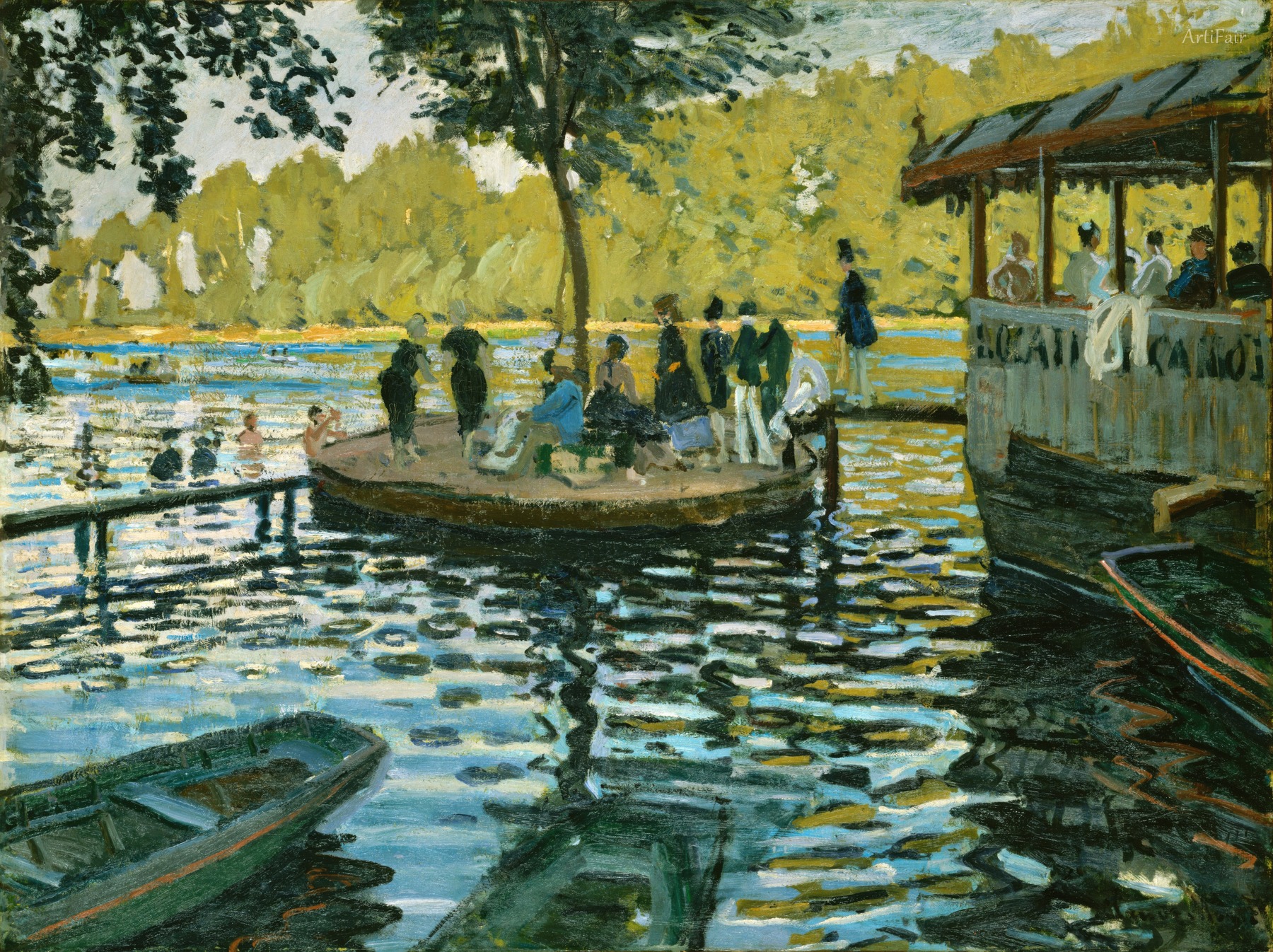
La Grenouillère is an oil on canvas painted by Claude Monet in 1869 at the bathing place of that name on the Seine; it is in the Metropolitan Museum of Art, New York.
La Grenouillère was a popular middle-class resort near Bougival, with bathing, boat hire and a floating café, easily reached by train from Paris. Promoted as 'Trouville-sur-Seine', it had recently been visited by Napoleon III, the Empress Eugénie and their son, and it later served as the setting for Guy de Maupassant's 1881 story 'La femme de Paul'. Monet and Pierre-Auguste Renoir, both very poor and close friends at the time, saw in it an ideal subject for the scenes of modern leisure they hoped to sell. On 25 September 1869 Monet wrote to Frédéric Bazille that he dreamed of a painting of the baths of La Grenouillère, for which he had made some bad sketches, and that Renoir also wanted to paint it.
This canvas and another in the National Gallery, London are probably among the sketches Monet mentioned; a larger painting, formerly in the Arnhold collection in Berlin and now lost, may have been the finished picture he had in mind. The broad, constructive brushstrokes are those of a sketch, unlike the more carefully worked surfaces of his exhibition pictures of the period. The view shows the small round island known as the Camembert, crowded with figures, and the gangplank leading to the floating restaurant, with hired boats moored in the foreground. Monet builds the scene from repeated elements, ripples, foliage, boats and figures, in strokes that remain descriptive. Renoir painted an almost identical view, now in the Nationalmuseum, Stockholm, and the two evidently worked side by side.
The canvas measures 74.6 by 99.7 cm. It formed part of the H. O. Havemeyer Collection and came to the Met in 1929 as a bequest of Louisine Havemeyer.