
Hearts are Trumps
Category:
Created:
Date unknown
Likes:
1
Dimensions:
Download:
New users get 4 free credits. 2K costs 1 credit; 4K and Ultra HD are priced by resolution. Public domain artworks can be used commercially.
Dominant colors
Public domain download summary
This artwork is provided as a public domain image resource. The 2K file costs 1 credit for everyday creative work, while 4K and Ultra HD files are priced by resolution.
Art Appreciation
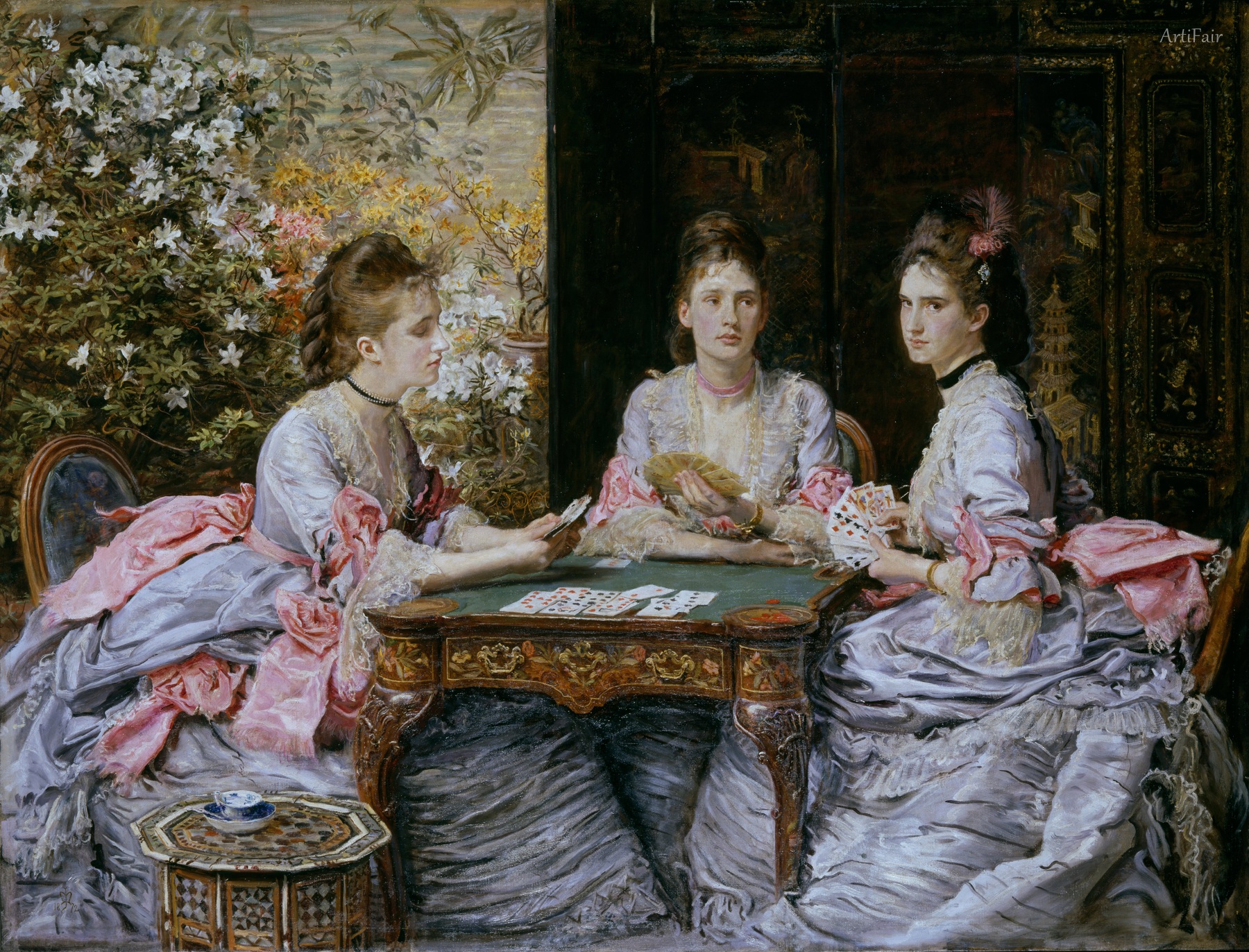
Hearts are Trumps is an oil painting on canvas by John Everett Millais, shown at the Royal Academy in 1872; it is a portrait of Elizabeth, Diana and Mary Armstrong and has belonged to Tate in London since the Trustees of the Chantrey Bequest presented it in 1945.
The sitters, then in their twenties, were the daughters of Walter Armstrong, a prosperous merchant and collector who commissioned the picture, and sisters of the future Sir Walter Armstrong, an art critic who later became director of the National Gallery of Ireland. Tate's caption suggests their father hoped the portrait would raise the family's social standing. According to Millais's son, the painter took the subject as a challenge after a reviewer claimed he could never paint three beautiful women together in modern dress as Joshua Reynolds had in The Ladies Waldegrave of 1781, and comparisons with that work have been made ever since. Tate also notes that Millais borrowed the title and the arrangement from a popular photograph of the period.
The sisters sit around a gilt card table in identical fashionable dresses, set against banks of flowers on one side and a lacquered screen on the other. Mary, at right, looks straight out at the viewer and holds most of the trumps. The title and the game hint at a contest between the sisters over who would marry first, and present courtship as a game the young women were learning to play. Tate's label describes the result as a gentle and nostalgic vision of family life, close in style to Reynolds and flattering to its fashionable sitters.
After years of discoloured varnish had flattened the colours, Tate conservator Natasha Duff spent five months cleaning the picture before its return to display at Tate Britain, revealing brighter colour and loose, lively brushwork; the frame, probably the original, was restored at the same time. The canvas measures 165.7 by 219.7 cm.