
The Magpie on the Gallows
Category:
Created:
1568
Likes:
0
Dimensions:
Download:
New users get 4 free credits. 2K costs 1 credit; 4K and Ultra HD are priced by resolution. Public domain artworks can be used commercially.
Dominant colors
Public domain download summary
This artwork is provided as a public domain image resource. The 2K file costs 1 credit for everyday creative work, while 4K and Ultra HD files are priced by resolution.
Art Appreciation
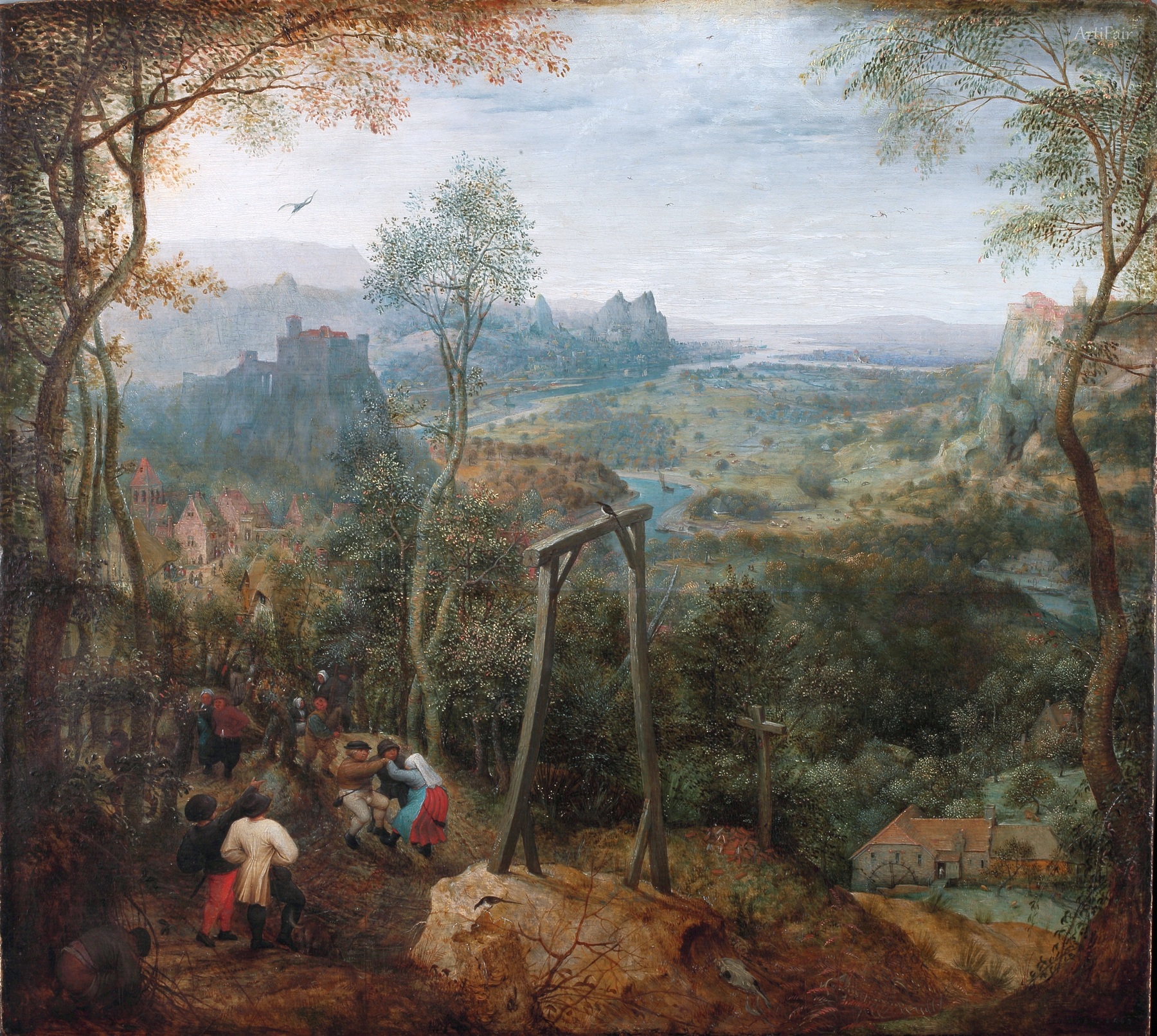
The Magpie on the Gallows is a small oil painting on panel by Pieter Bruegel the Elder, usually dated 1568, in the Hessisches Landesmuseum, Darmstadt.
The date, read as 1568, would make it one of Bruegel's last works before his death in 1569, perhaps his very last. According to his biographer Karel van Mander, Bruegel left the picture to his wife, saying that the magpies stood for gossips he wished to see hanged, and had her burn a number of overly satirical drawings to protect the family. The small format and the steep bird's-eye landscape have, however, led some scholars to consider an earlier date in the 1550s. Why and for whom it was painted is unknown.
The viewer looks down on a raised woodland clearing. Peasants dance to a bagpiper beside a gallows on which a magpie perches, almost exactly at the centre of the picture; a second magpie sits at its foot near an animal skull. The gallows is drawn as an impossible object: its posts seem to stand side by side, while the crossbeam recedes into depth. People appear only on the left, where a man relieves himself in the shadows, an allusion to the Netherlandish saying about defecating on the gallows, that is, mocking death and authority. To the right stand a cross and a watermill, and the view opens onto a winding river, a town, a castle and distant hills, the brown foreground giving way to green and then blue to create depth.
The painting was made shortly after the Duke of Alba arrived in the Netherlands in 1567, sent by Philip II to crush the religious and political unrest, and the gallows has been read as the death penalty then threatening Protestant preachers. It also plays on proverbs about dancing under the gallows and on the belief that gossip leads to hanging. It measures about 46 × 51 cm.