
Italian Coast Scene with Ruined Tower
Category:
Created:
Date unknown
Likes:
0
Dimensions:
Download:
New users get 4 free credits. 2K costs 1 credit; 4K and Ultra HD are priced by resolution. Public domain artworks can be used commercially.
Dominant colors
Public domain download summary
This artwork is provided as a public domain image resource. The 2K file costs 1 credit for everyday creative work, while 4K and Ultra HD files are priced by resolution.
Art Appreciation
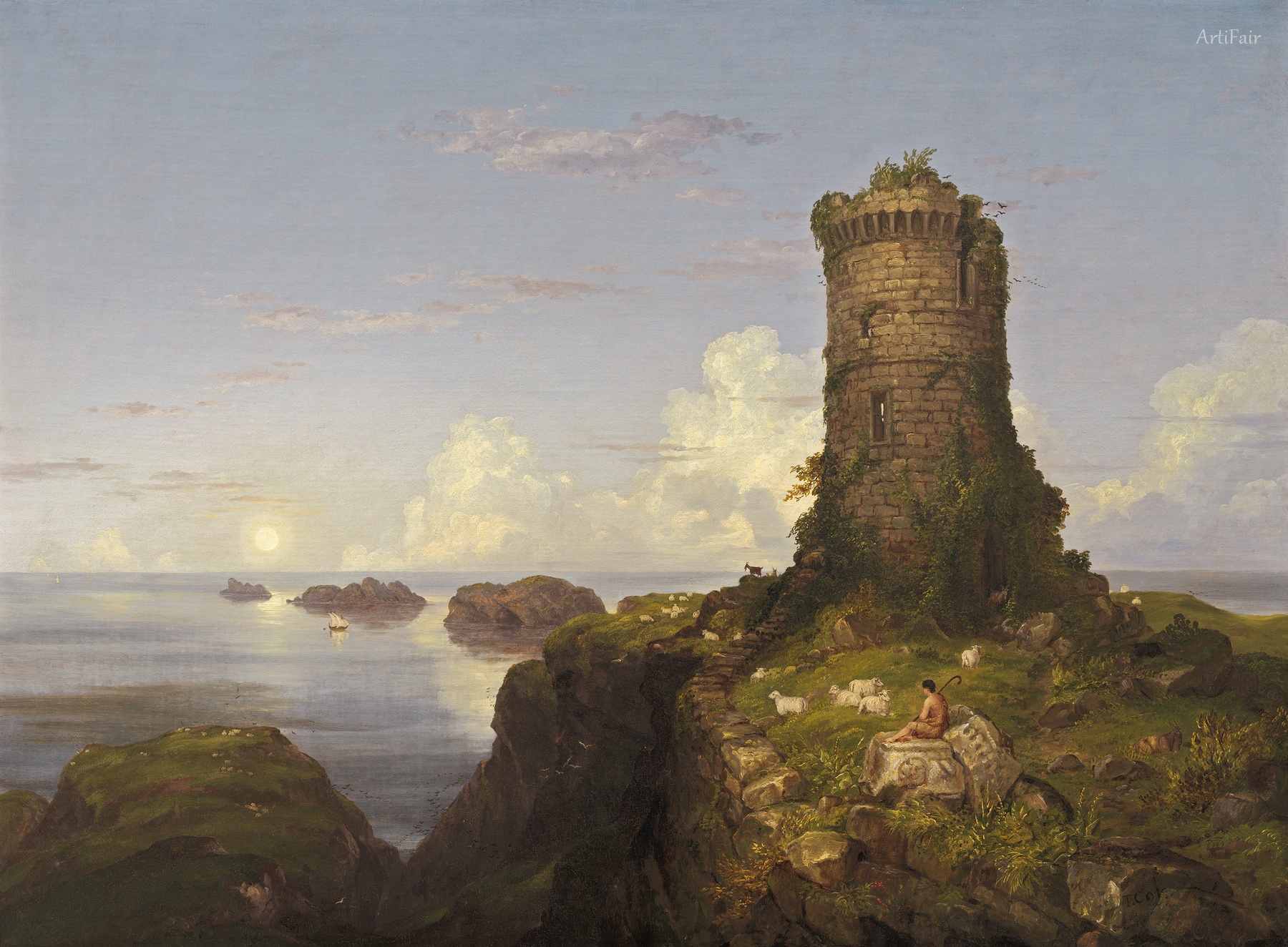
Italian Coast Scene with Ruined Tower is an oil painting on canvas by Thomas Cole, dated 1838, in the National Gallery of Art, Washington (1993.55.1). It measures 86.4 by 116.8 cm.
The motif goes back to Cole's first European journey. In London in 1829 he admired John Constable's Hadleigh Castle, with its ruined medieval tower on a high hill, and in Italy in 1831–32 he sketched similar sites; back in America he painted several pictures of circular towers in lonely landscapes. This canvas began as a commission for a scene from Byron's poem The Corsair. When that subject proved difficult, Cole turned to Coleridge's introduction to The Ballad of the Dark Ladie, which describes a ruined tower by moonlight, but he grew troubled and doubtful as he worked. Feeling hemmed in by illustrating another writer's imagery, he dropped the literary sources and made the picture his own.
On 22 May 1838 Cole wrote in his journal that he was painting a ruined and solitary tower standing on a craggy promontory whose base is washed by a calm ocean, and that he hoped its stillness and loneliness might reach the imagination. The finished canvas shows exactly that: an ivy-covered round tower crowning a rocky headland, a shepherd seated on a fallen block among his sheep, and beyond, rocky islets and a low sun over a glassy sea. The National Gallery of Art reads it as one of Cole's major statements on the mutability of human works and the transience of life, ideas he also expressed in his poetry.
The painting is probably the one Cole exhibited in Boston in 1839 as Italian Seashore, with Tower. It then dropped out of view and was unknown to modern Cole scholarship until it came to light and was acquired by the National Gallery in 1993, a gift of The Circle of the National Gallery of Art, after descending in a Massachusetts family.