
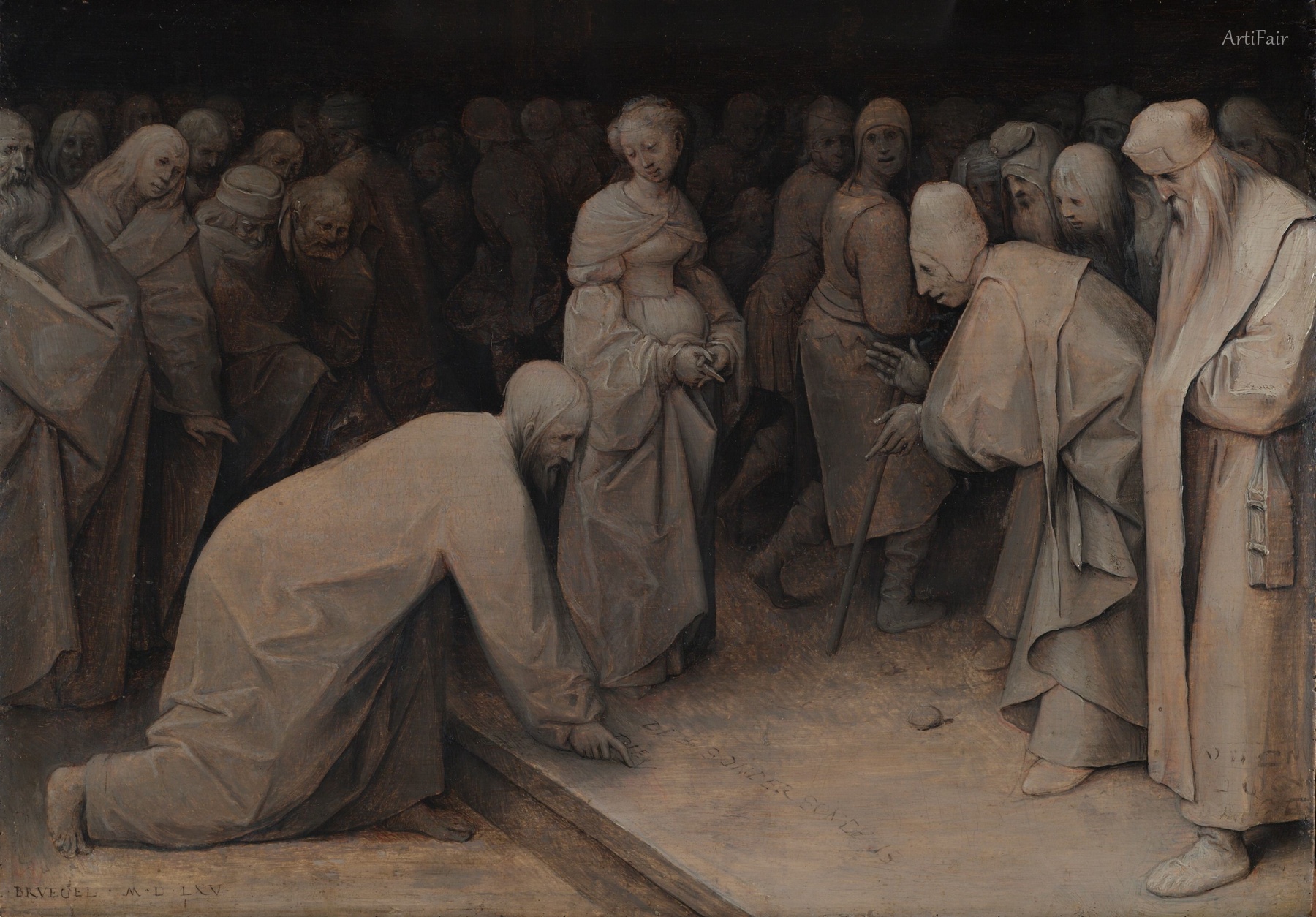
Christ and the Woman Taken in Adultery
Category:
Created:
1565
Likes:
0
Dimensions:
Download:
New users get 4 free credits. 2K costs 1 credit; 4K and Ultra HD are priced by resolution. Public domain artworks can be used commercially.
Dominant colors
Public domain download summary
This artwork is provided as a public domain image resource. The 2K file costs 1 credit for everyday creative work, while 4K and Ultra HD files are priced by resolution.
Art Appreciation
Christ and the Woman Taken in Adultery is a small grisaille (near-monochrome) oil painting on panel by Pieter Bruegel the Elder, signed and dated 1565 and now in the Courtauld Gallery, London. It measures 24.1 by 34.4 cm.
The episode comes from the Gospel of John: scribes and Pharisees bring Jesus a woman caught in adultery, a crime punishable by stoning, to test him. Bruegel shows Christ kneeling in the foreground as he writes on the ground, in Flemish, the opening of his reply, DIE SONDER SONDE IS DIE (he that is without sin). The woman stands behind him, unthrown stones lie on the floor, and a crowd of onlookers fills the background. The signature BRVEGEL.M.D.LXV is at the lower left. The calm grouping and large figures have been called perhaps the most Italianate in his paintings, and the woman is unusually idealised for Bruegel.
Grisaille is rare in his surviving work; the other examples are the tiny Three Soldiers in the Frick Collection and The Death of the Virgin at Upton House. Bruegel kept this panel rather than selling it, and it served as a model: Paul Perret published an engraving after it in 1579, the edges of the panel carry pricks from a copying grid, and copies were made by others, among them a more colourful version attributed to Pieter Brueghel the Younger.
According to the Courtauld, the panel passed to Jan Brueghel the Elder, who bequeathed it to Cardinal Federico Borromeo in 1625; Borromeo returned it to Jan Brueghel the Younger in Antwerp. It later went to England, was sold at Christie's in 1834 and again in 1952, and was acquired by Count Antoine Seilern, who bequeathed it to the Courtauld in 1978. Stolen from the gallery on 2 February 1982, it proved impossible to sell openly and was recovered in 1992.