
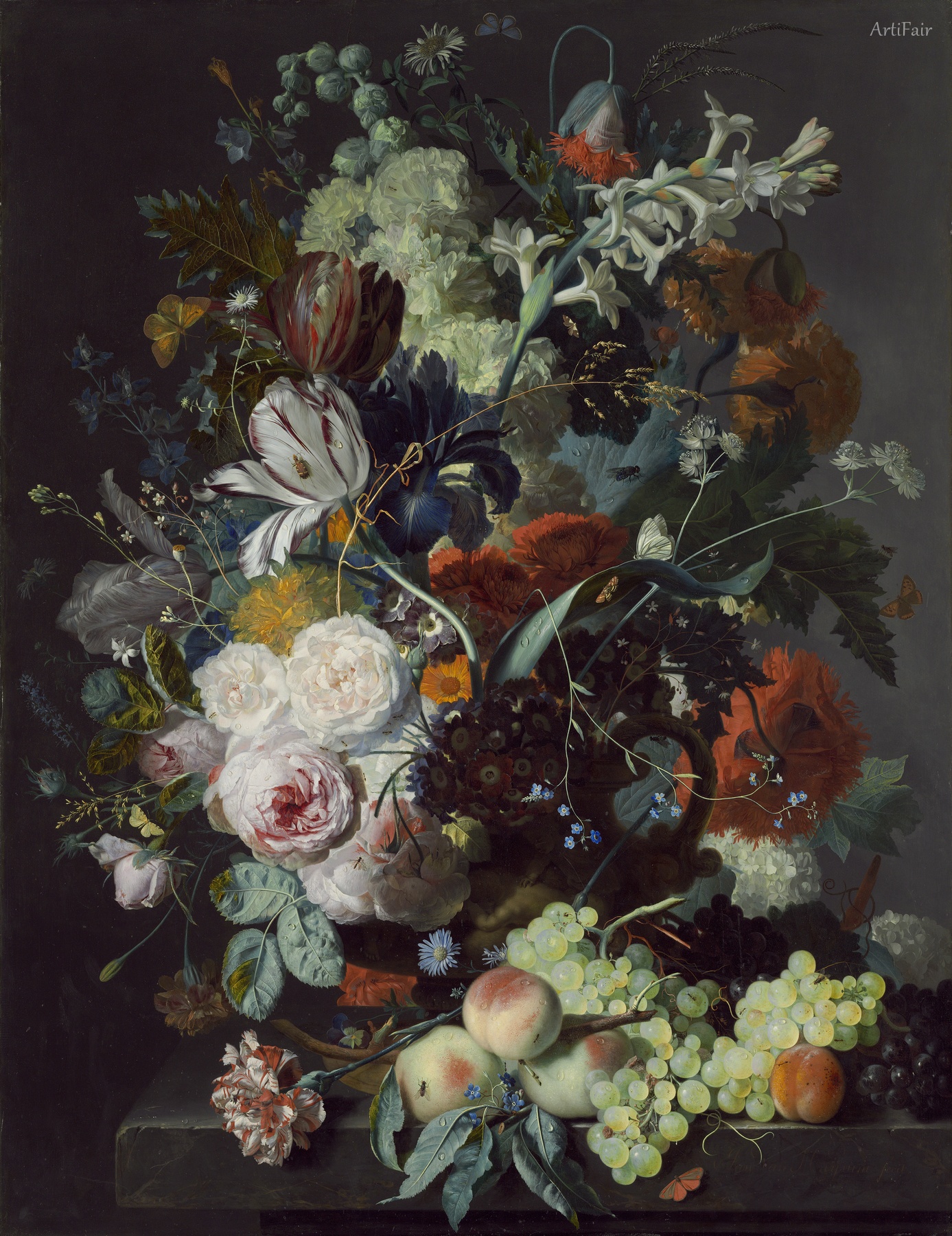
Still Life with Flowers and Fruit
Category:
Created:
1715
Likes:
0
Dimensions:
Download:
New users get 4 free credits. 2K costs 1 credit; 4K and Ultra HD are priced by resolution. Public domain artworks can be used commercially.
Dominant colors
Public domain download summary
This artwork is provided as a public domain image resource. The 2K file costs 1 credit for everyday creative work, while 4K and Ultra HD files are priced by resolution.
Art Appreciation
Still Life with Flowers and Fruit is an oil painting on panel by the Amsterdam flower painter Jan van Huysum, made around 1715 and now in the National Gallery of Art, Washington (accession 1996.80.1).
Van Huysum (1682–1749) came from a family of decorative painters and became the most sought-after flower specialist of his day; his pictures were bought by princes and could fetch several times the price of a Rembrandt. He worked from fresh blooms gathered over the seasons, so his bouquets combine flowers that never opened at the same moment, and he guarded his methods closely. The dark ground of this panel is typical of his work in the second decade of the eighteenth century. In his catalogue entry for the National Gallery, Arthur Wheelock compares it with a flower piece in Karlsruhe dated 1714 and notes that shortly after 1720 Van Huysum changed course and began to set his bouquets against light backgrounds, in step with his patrons' taste.
On a stone ledge, a terracotta vase decorated with putti almost disappears beneath the bouquet. Peonies, roses, carnations and auriculas form the dense core, while striped tulips, veronica, tuberoses and hops wind through it; a large red bud of the opium poppy, flanked by a hollyhock and a tuberose, sits at the top. Peaches and green and purple grapes lie on the ledge, and small butterflies, flies and drops of water are scattered over petals and fruit, lit strongly from the front so that the edges fall into shadow.
The panel measures 78.7 × 61.3 cm. It belonged to Baron Louis de Rothschild in Vienna and then to his niece Bettina, Baroness Reininghaus, and her husband; after passing through Galerie Sanct Lucas in Vienna it was bought around 1994 by Philip and Lizanne Cunningham, who sold it in part and gave it in part to the National Gallery of Art in 1996.