
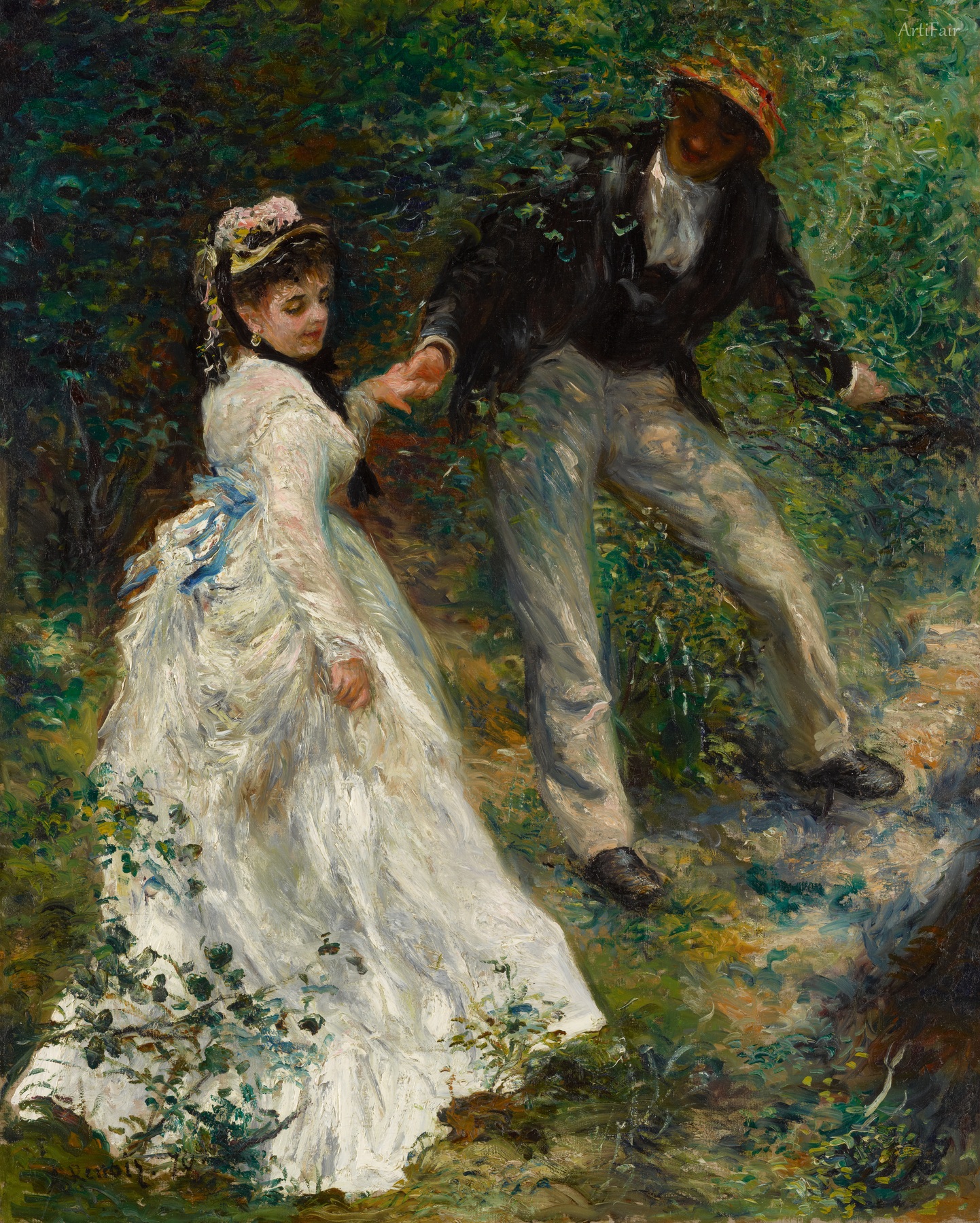
La Promenade
Category:
Created:
1870
Likes:
0
Dimensions:
Download:
New users get 4 free credits. 2K costs 1 credit; 4K and Ultra HD are priced by resolution. Public domain artworks can be used commercially.
Dominant colors
Public domain download summary
This artwork is provided as a public domain image resource. The 2K file costs 1 credit for everyday creative work, while 4K and Ultra HD files are priced by resolution.
Art Appreciation
La Promenade is an oil-on-canvas painting by Pierre-Auguste Renoir from 1870, in the J. Paul Getty Museum, Los Angeles (89.PA.41). It measures 81.3 by 65 cm and shows a young couple on an outing from the city, the man leading the woman by the hand along a path through bushes and trees.
Renoir's own title for the picture is unknown; La Promenade was given by owners offering it for sale in 1898. The summer before, in 1869, he had painted outdoors with Claude Monet at La Grenouillère, and Monet encouraged him towards a lighter, more luminous range of colour and the feathery brushwork he favoured. In 1870 Renoir was living with his mother at Louveciennes. On 19 July 1870 France declared war, beginning the Franco-Prussian War, and Renoir was called up and served four months in the cavalry without seeing combat.
The subject draws on the light-hearted garden outings of eighteenth-century painters such as Antoine Watteau and Jean-Honoré Fragonard, whose works Renoir had studied in the Louvre, and reflects the Rococo revival of the Second Empire. The Getty contrasts it with those earlier images of seduction: here the moment seems caught by chance, with middle-class Parisians immersed in nature, perhaps a local park or the banks of the Seine, rather than posed before a studio backdrop. Renoir kept something of Gustave Courbet's greens and browns but used a thin, oily paint in glazes that float into one another, and the dappled light falling through the leaves anticipates his Impressionist work of the 1870s and 1880s. Henri Loyrette wrote that the picture at last achieves what Renoir had long sought, the integration of the figure in a landscape. The woman is generally thought to have been modelled by Lise Tréhot; the man, with his boater, may be a boatman, and older accounts identified the pair as Alfred Sisley and Rapha, companion of the musician Edmond Maître.
The painting passed through collections including those of Gustave Goupy, Paul Durand-Ruel, Paul Cassirer, Bernhard Köhler, Paul Rosenberg and Nate B. and Frances Spingold, and later belonged to the British Rail Pension Fund before the Getty acquired it in 1989.