
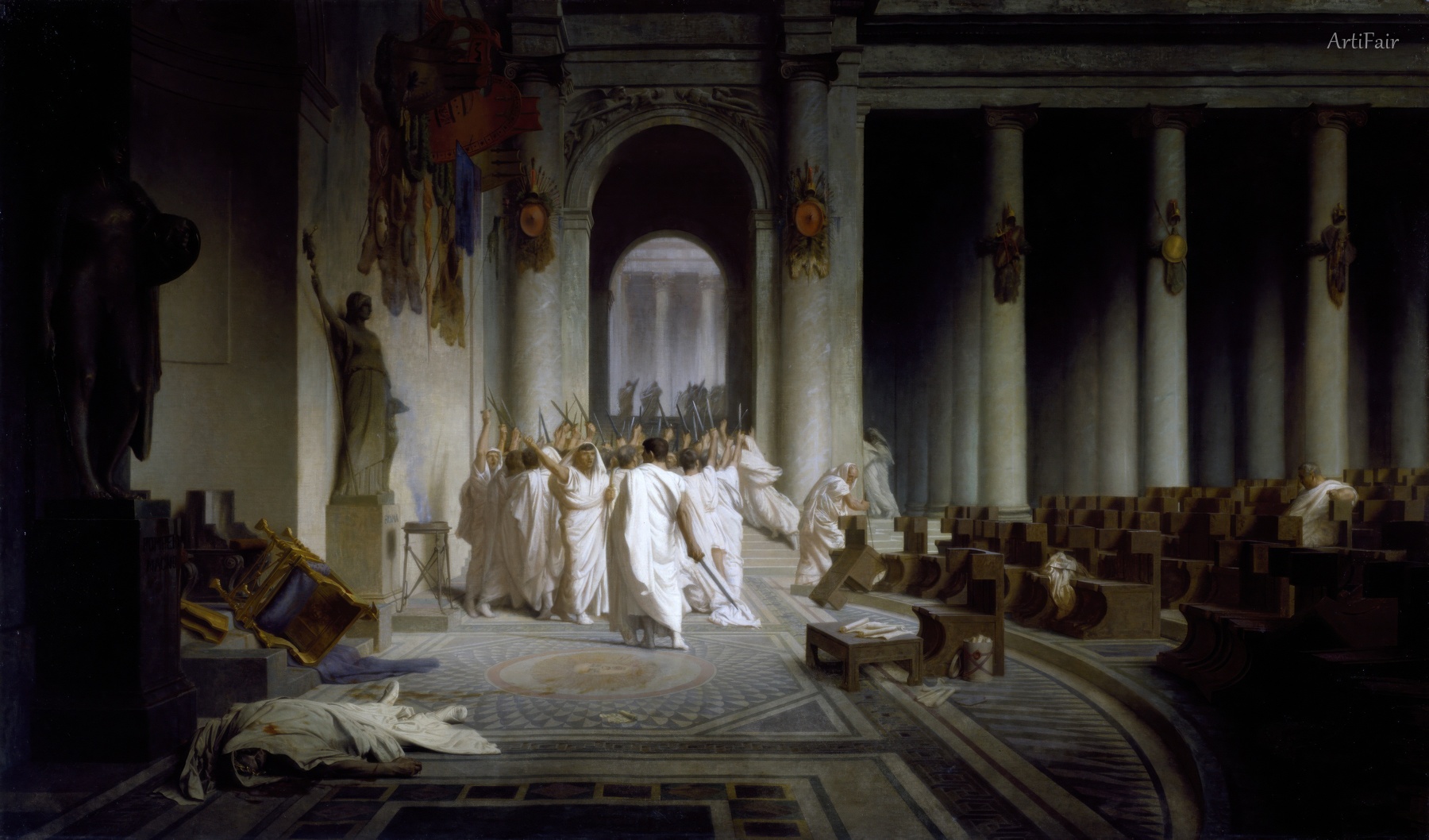
The Death of Caesar
Category:
Created:
1867
Likes:
0
Dimensions:
Download:
New users get 4 free credits. 2K costs 1 credit; 4K and Ultra HD are priced by resolution. Public domain artworks can be used commercially.
Dominant colors
Public domain download summary
This artwork is provided as a public domain image resource. The 2K file costs 1 credit for everyday creative work, while 4K and Ultra HD files are priced by resolution.
Art Appreciation
The Death of Caesar (La Mort de César) is an oil painting on canvas by Jean-Léon Gérôme, dated by the Walters Art Museum in Baltimore, which owns it, to 1859–1867; English Wikipedia gives 1867.
The scene is the Senate meeting in the hall of Pompey's theatre complex in Rome on the Ides of March, 15 March 44 BC. Typically for Gérôme, the painting shows not the murder itself but the moment just after it. Julius Caesar's body lies in the lower left corner, wrapped in his toga, at the foot of the statue of Pompey and beside an overturned chair. The conspirators, still holding up their blades, surge away in a jubilant group towards the arched doorway, while the rows of benches stand almost empty and a single senator remains seated at the right. The canvas measures 85.5 × 145.5 cm.
Gérôme's smooth, polished finish gave his history pictures an air of literal truth. One critic remarked that if photography had existed in Caesar's day, the picture could be believed to have been painted from a photograph taken at the very moment of the catastrophe. The same interest in the aftermath of violence appears in other works by Gérôme, such as The Duel After the Masquerade, The Execution of Marshal Ney and Jerusalem. According to the French Wikipedia article, the canvas was shown at the Brussels Salon of 1860, after which Gérôme was made a knight of the Order of Leopold.
The painting belonged to M. J. Allard and then to the New York collector John Taylor Johnston, whose sale in 1876 included it; it later passed to John Jacob Astor and the dealers Boussod, Valadon et Cie. Henry Walters bought it at a New York sale in April 1917 and bequeathed it to the museum in 1931. It was included in the exhibition The Spectacular Art of Jean-Léon Gérôme at the Getty, the Musée d'Orsay and the Thyssen-Bornemisza in 2010–2011.