
Diana and her Nymphs
Category:
Created:
1655
Likes:
0
Dimensions:
Download:
New users get 4 free credits. 2K costs 1 credit; 4K and Ultra HD are priced by resolution. Public domain artworks can be used commercially.
Dominant colors
Public domain download summary
This artwork is provided as a public domain image resource. The 2K file costs 1 credit for everyday creative work, while 4K and Ultra HD files are priced by resolution.
Art Appreciation
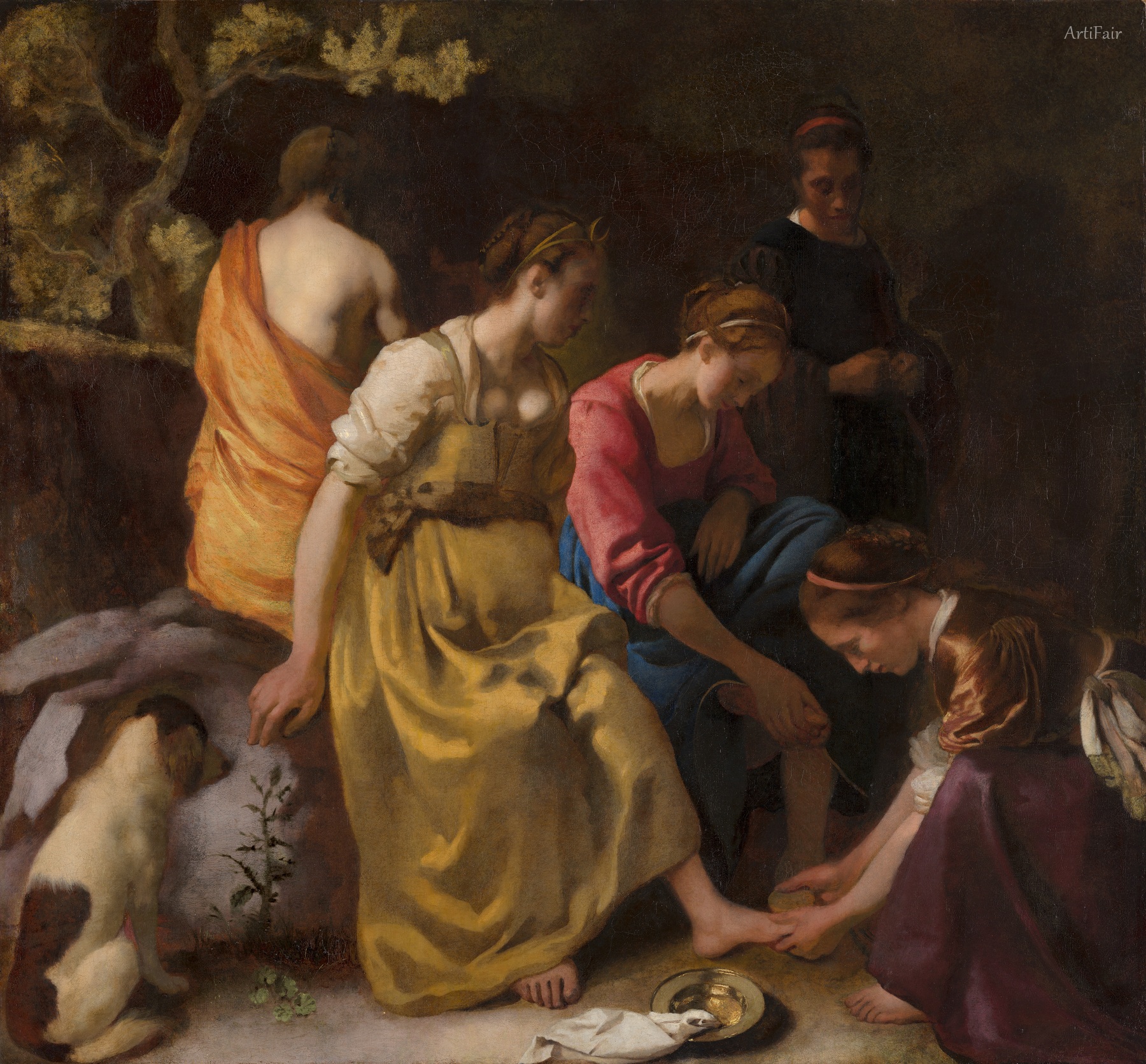
Diana and her Nymphs, also called Diana and Her Companions, is an oil painting on canvas by Johannes Vermeer from the early to mid-1650s (about 1653–1656), held by the Mauritshuis in The Hague since 1876.
It may be Vermeer's earliest surviving painting; scholars disagree whether it came before or after Christ in the House of Martha and Mary. The goddess Diana, a crescent moon on her diadem, sits on a rock in a loose yellow dress while a kneeling companion washes her foot over a brass basin. Another nymph, her back half bare, sits behind her, a third holds her own foot in a pose recalling the ancient Spinario, and a fourth stands apart with lowered eyes; a dog sits at lower left beside a thistle. Rather than the dramatic episodes of Actaeon or Callisto, Vermeer shows a quiet moment of the goddess's toilette, with no hunting gear and faces sunk in shadow. Arthur Wheelock found in it a solemnity closer to Christian than mythological tradition, the foot-washing recalling Mary Magdalene washing Christ's feet.
The stout figures, thick impasto and shadowed faces point to Rembrandt, and the mood has been compared with his Bathsheba of 1654; Carel Fabritius, Rembrandt's former pupil working in Delft, may have been the link. The picture has also often been compared with a Diana by Jacob van Loo of about 1648.
Nothing is known of its history before the mid-19th century. At the Goldsmid sale in Paris on 4 May 1876 it was bought for the Dutch state as a work by Nicolaes Maes, its signature having been altered; doubts about the attribution persisted until around 1901, when Abraham Bredius and Willem Martin noted its closeness to Martha and Mary. The canvas, now 98.5 × 105 cm, has been cut down, losing about 15 cm on the right, and the restoration of 1999–2000 found that the patch of blue sky at upper right was a 19th-century addition, which restorers covered with foliage.