
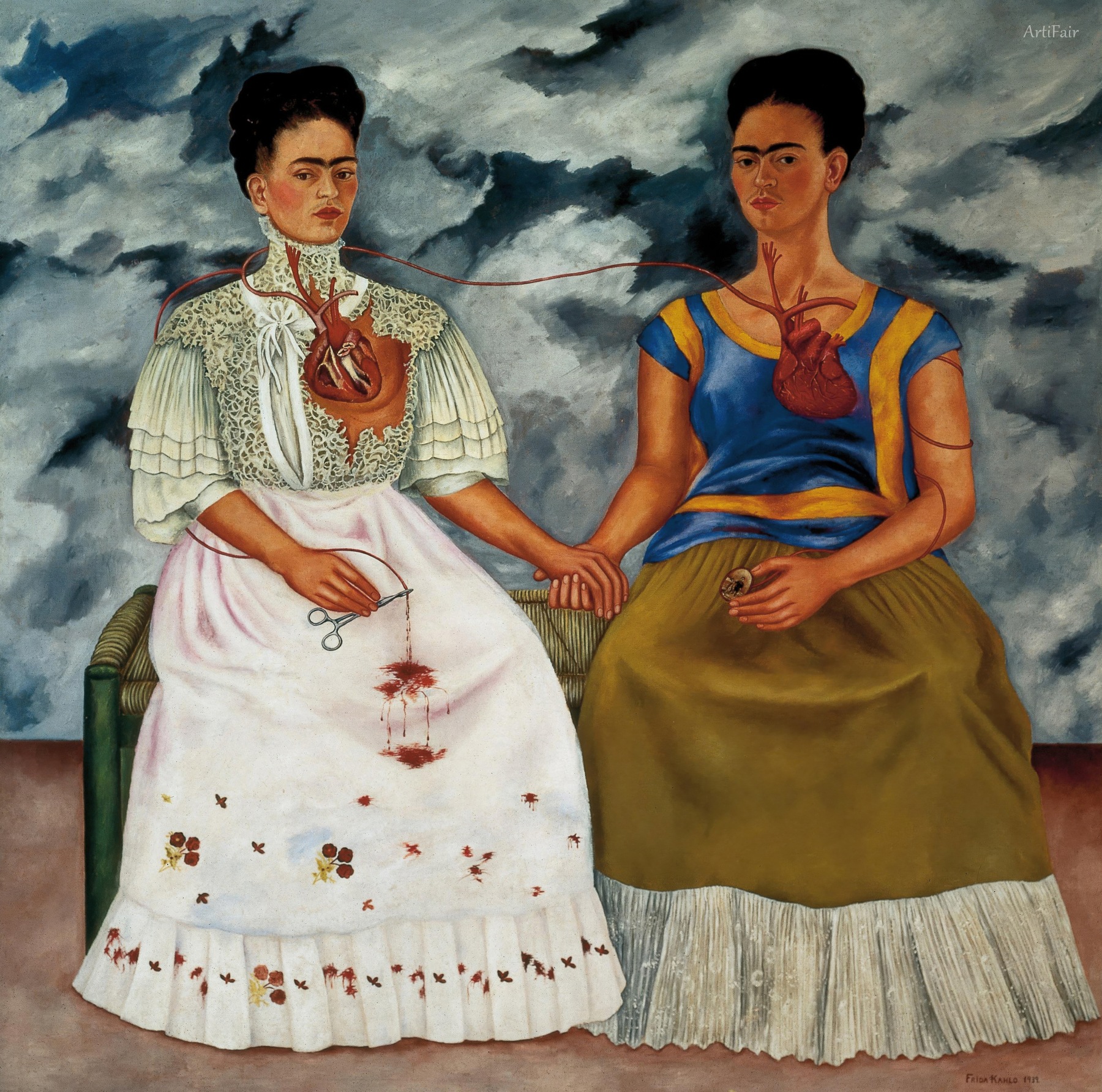
The Two Fridas
Category:
Created:
1939
Likes:
1
Dimensions:
Download:
New users get 4 free credits. 2K costs 1 credit; 4K and Ultra HD are priced by resolution. Public domain artworks can be used commercially.
Dominant colors
Public domain download summary
This artwork is provided as a public domain image resource. The 2K file costs 1 credit for everyday creative work, while 4K and Ultra HD files are priced by resolution.
Art Appreciation
The Two Fridas (Las dos Fridas) is an oil-on-canvas painting by the Mexican artist Frida Kahlo, made in 1939 and held by the Museo de Arte Moderno in Mexico City. Measuring 173.5 by 173 cm, it was her first large-scale canvas and is among her best-known works: two identical seated figures of the artist hold hands on a bench against a stormy sky.
Kahlo painted it in the year of her divorce from Diego Rivera, although the couple remarried a year later. According to her friend Fernando Gamboa, she conceived the double portrait after seeing Théodore Chassériau's The Two Sisters and the anonymous Gabrielle d'Estrées and One of Her Sisters at the Louvre earlier that year, when she traveled to Paris for her first European exhibition. In January 1940 the painting appeared with The Wounded Table at the International Surrealist Exhibition in Mexico City.
One Frida wears a white European-style Victorian dress; the other wears the traditional Tehuana costume that Rivera favored. Both have their hearts torn open, joined by a single artery that loops between them. The European Frida clamps the vessel with surgical forceps, so that blood drips onto her white skirt, while the Mexican Frida holds a miniature portrait of Rivera. Kahlo said the image recorded a childhood memory of an imaginary friend; interpreters have also read the pair as her dual German and Mexican heritage, as the loved and abandoned selves of the divorce, and as an allusion to Aztec sacrifice and to her life of surgical pain.
The painting remained in Kahlo's possession until 1947, when the Instituto Nacional de Bellas Artes acquired it; it entered the Museo de Arte Moderno on 28 December 1966. It has since become a central image in discussions of identity, gender and postcolonial Mexico, and it inspired, among other works, the 1998 Mexican play Las dos Fridas.