
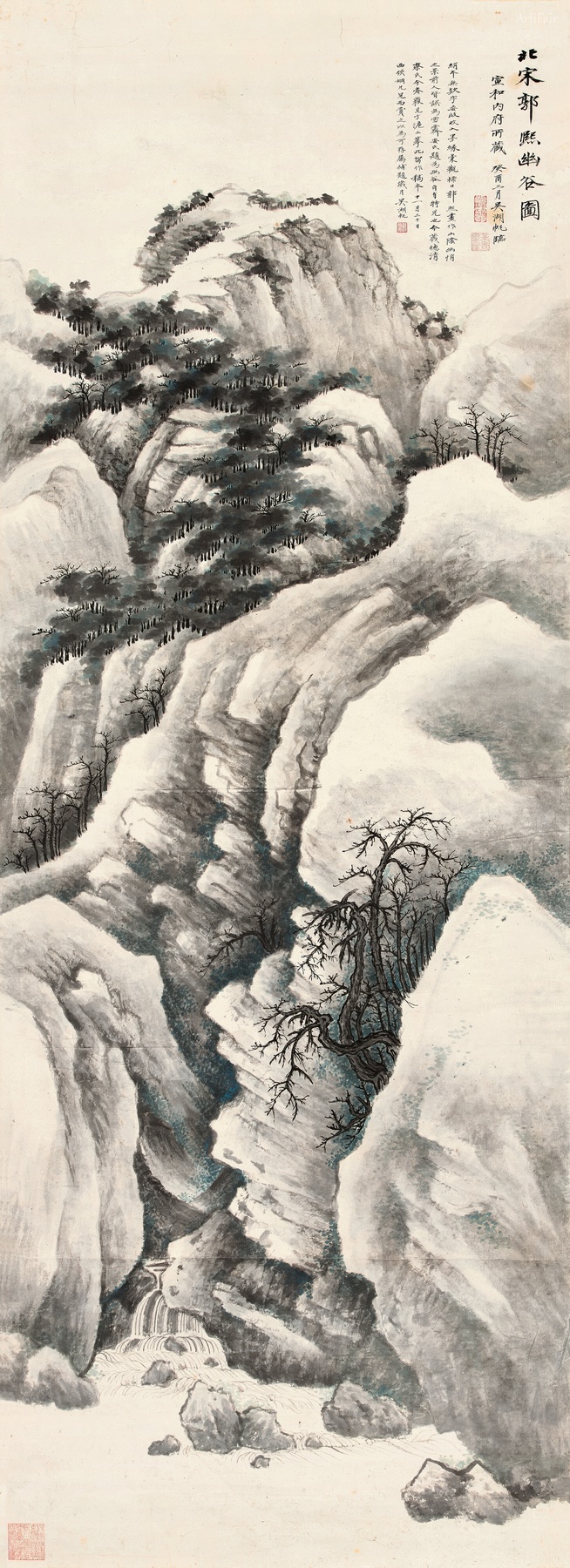
Copy of Guo Xi's 'Quiet Valley' (仿郭熙幽谷图)
Category:
Created:
1933
Likes:
0
Dimensions:
Download:
New users get 4 free credits. 2K costs 1 credit; 4K and Ultra HD are priced by resolution. Public domain artworks can be used commercially.
Dominant colors
Public domain download summary
This artwork is provided as a public domain image resource. The 2K file costs 1 credit for everyday creative work, while 4K and Ultra HD files are priced by resolution.
Art Appreciation
Copy of Guo Xi's Secluded Valley (Fang Guo Xi Yougu tu) is a hanging scroll in ink and light colour on paper by the Chinese painter and connoisseur Wu Hufan, made in early 1933 after the Northern Song landscape Secluded Valley by Guo Xi, which is now in the Shanghai Museum.
Wu Hufan (1894–1968), from Suzhou, was one of the leading painters and authenticators of Republican-era Shanghai and kept a large collection of old paintings in his studio, the Meijing Shuwu. According to his diary, on 31 January 1933 his friend Zhang Daqian brought him Guo Xi's original, then owned by Cai Jintai; Wu called it a genuine work on silk with lively brushwork that he could look at again and again. When the collector Ye Gongchuo dismissed it a few days later, Wu put this down to prejudice against its owner. The painting stayed in Wu's studio for at least sixteen days, and on 15 February he noted that he had copied a corner of it. Although he had grown up among famous collections, this was the first original by a Northern Song master he had seen.
Guo Xi (1023–c. 1085) painted Secluded Valley in ink on silk, a tall view of a deep ravine between sheer cliffs and bare trees; it was in the Northern Song imperial collection and is recorded in the Xuanhe huapu catalogue. Wu's copy, 145 × 52.5 cm, is slightly smaller than the original's 167.7 × 53.6 cm and adds pale colour. His title inscription reads, in translation, 'Guo Xi of the Northern Song, Secluded Valley, in the collection of the Xuanhe imperial household; copied by Wu Hufan in the second month of guiyou.' A second inscription notes that the silk original bears no signature, that the eighteenth-century collector An Qi recorded it as Guo Xi in his catalogue Moyuan huiguan, and that earlier viewers had mistaken its shadowed mountain scene for clearing after snow, whereas An Qi's title Secluded Valley showed real insight.
Wu used a fine, strong Xuan paper suited to light washes and had the scroll mounted in the Xuanhe style of its Song model. It has been reproduced in several books on Wu Hufan and was offered at the Xiling Yinshe spring auction in 2009.