
Jealousy
Category:
Created:
1913
Likes:
0
Dimensions:
Download:
New users get 4 free credits. 2K costs 1 credit; 4K and Ultra HD are priced by resolution. Public domain artworks can be used commercially.
Dominant colors
Public domain download summary
This artwork is provided as a public domain image resource. The 2K file costs 1 credit for everyday creative work, while 4K and Ultra HD files are priced by resolution.
Art Appreciation
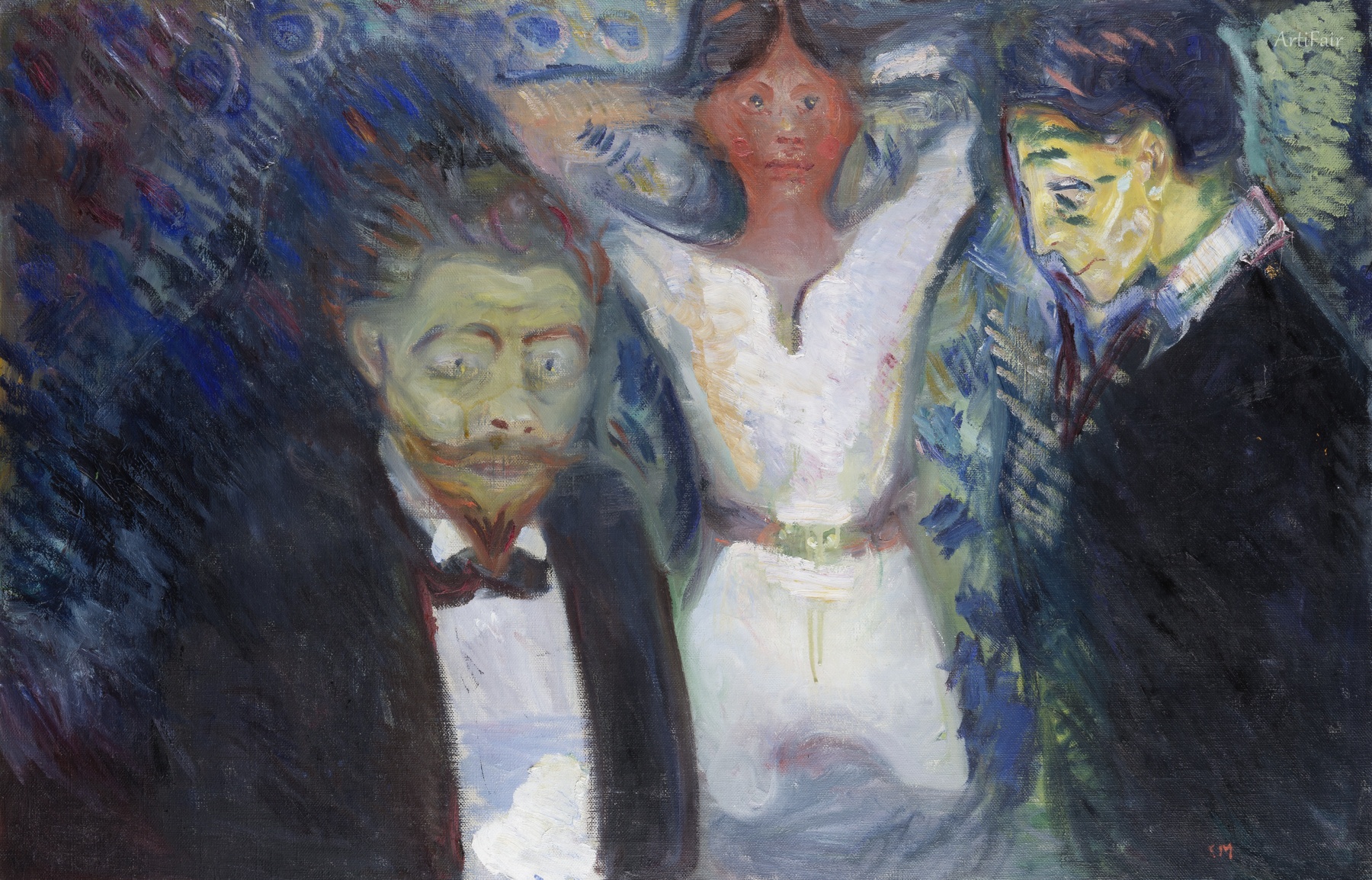
Jealousy is an oil-on-canvas painting by Edvard Munch from 1913, showing a woman in white between two men; it has been on permanent loan from a private collection to the Städel Museum in Frankfurt am Main since 2002 (inventory LG 19).
Jealousy was one of Munch's lifelong themes. The first painting of 1895, now in Bergen and part of the Frieze of Life, is generally read as an image of the triangle between the Polish writer Stanisław Przybyszewski, his wife, the Norwegian writer Dagny Juel, and Munch himself, all members of the Berlin bohemian circle around the tavern Zum schwarzen Ferkel in the early 1890s. Gerd Woll's catalogue raisonné lists twelve paintings with jealousy in the title, made between 1895 and 1935, and in the versions of 1907 and 1913 the woman in a white dress stands at the centre; Munch also made an etching of this composition in 1914.
In the Städel canvas, 85 by 130 cm and monogrammed EM at lower right, the woman, in a white dress with a belt at the waist, raises her arms behind her head. On the left Przybyszewski, as the museum identifies him, stares ahead with a face green with frenzy, while the man on the right, bearing Munch's own features, looks down, withdrawn. As in the other variations, the jealous man seems to see the lovers' scene in his mind's eye rather than look at it.
By 1913 the quarrels over Dagny Juel, who had married Przybyszewski in 1893 and was shot in Tiflis in 1901, lay far in the past. The Städel connects the femme fatale of Munch's later work instead with his stormy relationship with his former lover Tulla Larsen, whose quarrels tormented him for years after their separation. The woman in these later versions moves away from Juel as a model towards a general type of strong, self-assured woman who both attracted and intimidated the painter.