
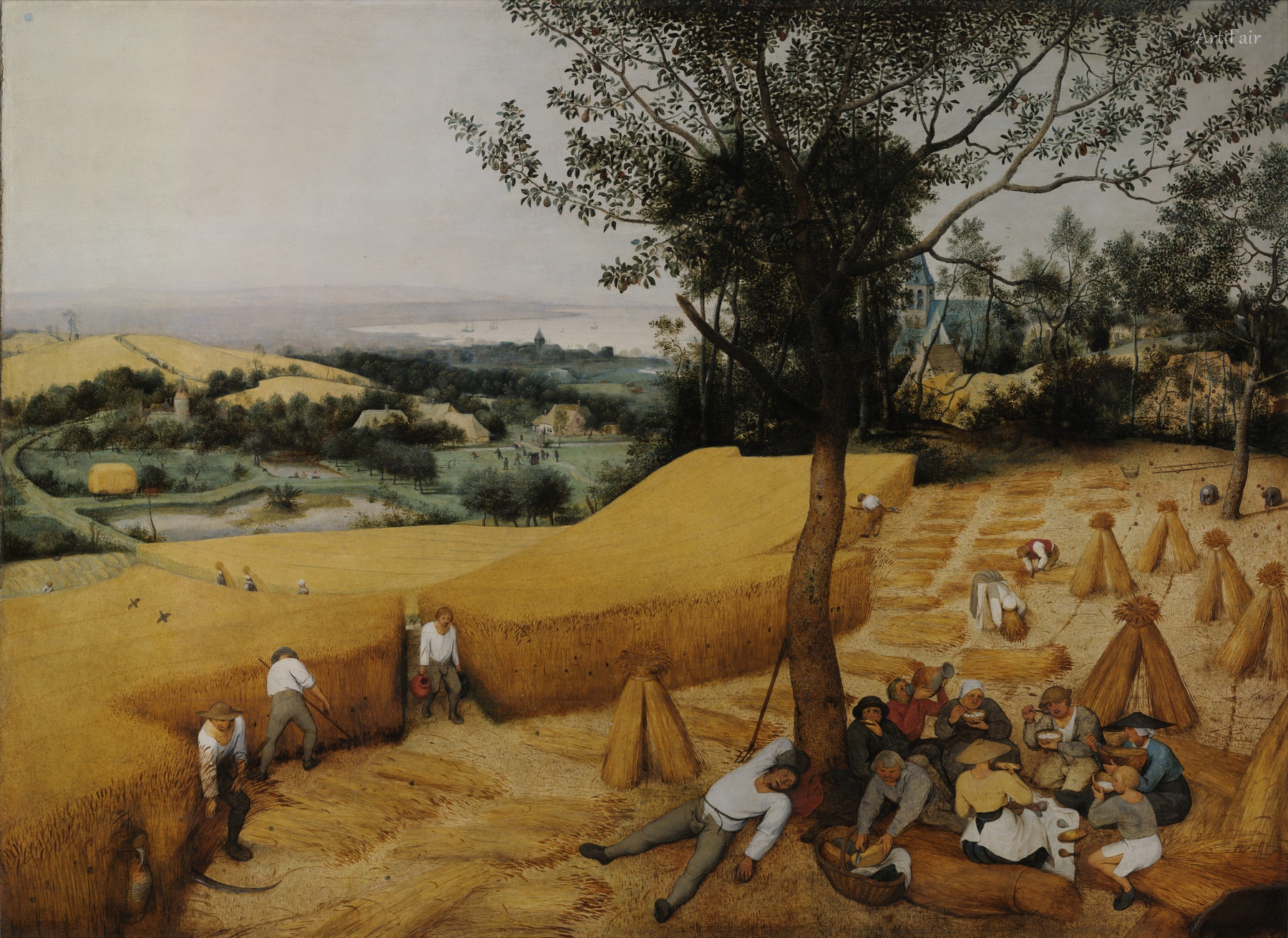
The Harvesters
Category:
Created:
1565
Likes:
0
Dimensions:
Download:
New users get 4 free credits. 2K costs 1 credit; 4K and Ultra HD are priced by resolution. Public domain artworks can be used commercially.
Dominant colors
Public domain download summary
This artwork is provided as a public domain image resource. The 2K file costs 1 credit for everyday creative work, while 4K and Ultra HD files are priced by resolution.
Art Appreciation
The Harvesters is an oil painting on oak panel by Pieter Bruegel the Elder, signed and dated 1565, in the Metropolitan Museum of Art, New York, which bought it in 1919.
The Antwerp merchant banker and collector Nicolaes Jongelinck commissioned it as part of a cycle of six paintings of the times of the year, five of which survive: The Gloomy Day, The Hunters in the Snow and The Return of the Herd in Vienna, The Hay Harvest in Prague, and this panel. Each covers two months; The Harvesters stands for late summer, identified by different writers as July and August or as August and September, with the yellow of ripe grain as its dominant colour. The Metropolitan describes the cycle as a watershed in the history of Western art, landscapes that no longer need a religious pretext.
A slender pear tree divides the picture. At left, reapers cut the wheat and a man climbs a path through the field carrying jugs, while others carry sheaves down towards the village. In the shade at right a group of workers eat bread, porridge and pears around a white cloth, one exhausted man sleeps under the tree, and beyond them figures bind sheaves and gather fallen fruit. In the distance villagers bathe in a pond, children play, a group takes part in the blood sport of cock throwing, and ships sail on a bay. Bruegel reused the motif of the sleeper beneath a tree two years later in The Land of Cockaigne.
The cycle passed from Jongelinck to Archduke Ernst in 1594 and later to the imperial collection in Vienna. In 1809 The Harvesters was taken to Paris by Count Antoine-François Andréossy, the French governor of Vienna; it later belonged to Paul Jean Cels in Brussels, from whom the Metropolitan acquired it. The signature 'BRVEGEL' and part of the date came to light when it was cleaned in 1920. Including later added strips the panel measures 119 × 162 cm.