
The Tower of Babel
Category:
Created:
1563
Likes:
0
Dimensions:
Download:
New users get 4 free credits. 2K costs 1 credit; 4K and Ultra HD are priced by resolution. Public domain artworks can be used commercially.
Dominant colors
Public domain download summary
This artwork is provided as a public domain image resource. The 2K file costs 1 credit for everyday creative work, while 4K and Ultra HD files are priced by resolution.
Art Appreciation
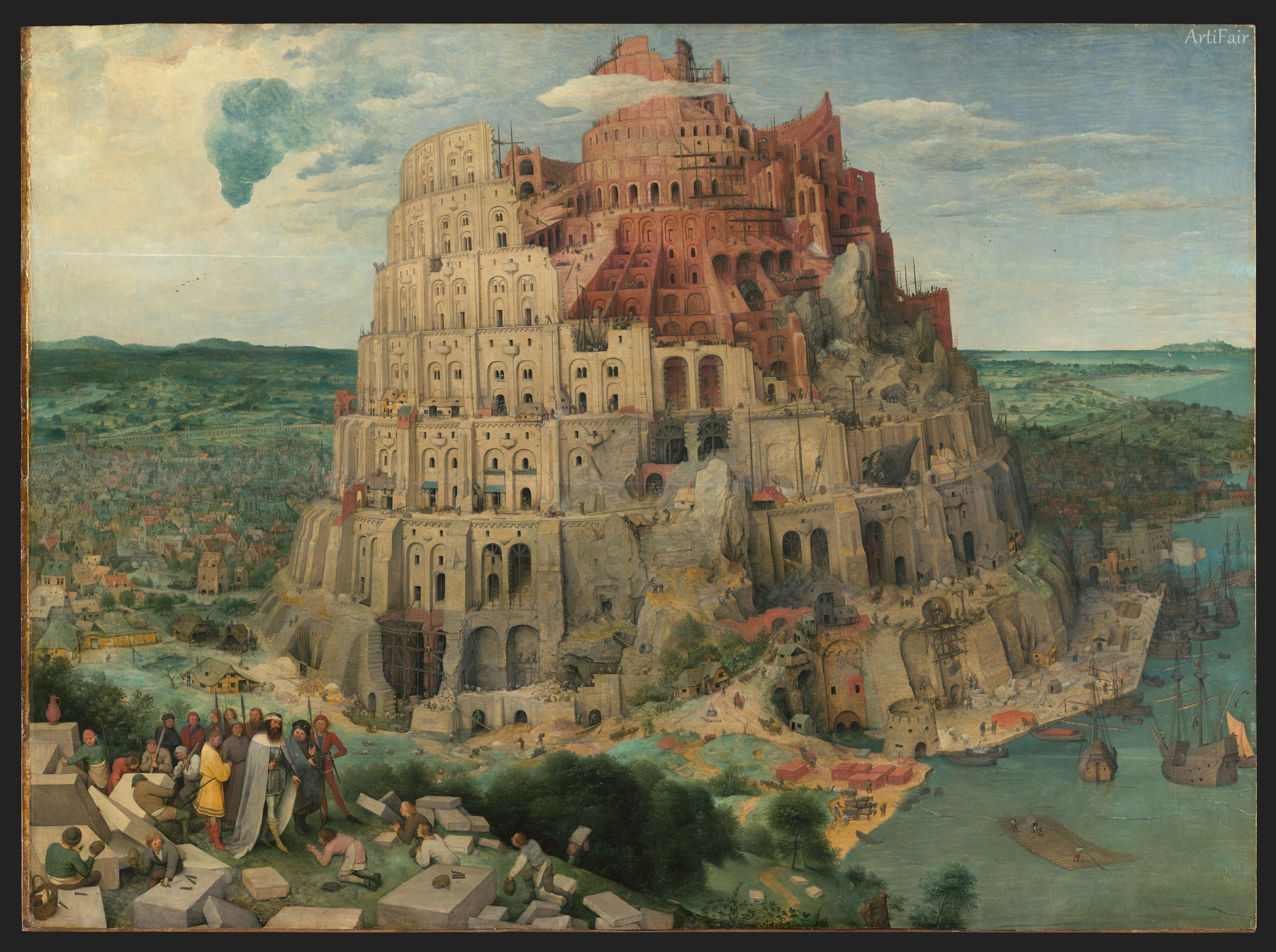
The Tower of Babel is an oil painting on oak panel by Pieter Bruegel the Elder, signed and dated 1563, in the Kunsthistorisches Museum, Vienna; it is the larger of his two surviving versions of the subject, often called the Great Tower of Babel.
Bruegel returned to the subject several times. A miniature on ivory, painted in Rome in 1552–53, is lost; a smaller panel in the Museum Boijmans Van Beuningen, Rotterdam, shares the composition but differs in many details and is generally thought to be later. The Vienna panel was made for the Antwerp banker Nicolaes Jongelinck, one of Bruegel's chief patrons, and later passed through the collections of Emperor Rudolf II and Archduke Leopold Wilhelm. The signature, 'BRVEGEL. FE. M.CCCCC.LXIII', is carved on a stone block in front of the king.
The Book of Genesis tells how a united, single-language humanity tried to build a tower reaching to heaven and was punished by the confusion of tongues. Bruegel concentrates on the building work. In the foreground King Nimrod, traditionally held to have ordered the tower, inspects the stonemasons. The tower, rising in a spiral around a small rocky peak, recalls the Roman Colosseum, which Bruegel had seen in 1552–53 and which Christians of his day associated with pride and persecution. Its arches are set at right angles to the sloping ground, some are already crumbling, and the lower storeys are unfinished while the upper ones go up. The subject was read as pride punished and as a lesson on the futility of human striving.
The Kunsthistorisches Museum notes that a seemingly Flemish port, tiny beside the tower, gives the scale, and that Bruegel records countless building and craft processes in encyclopaedic detail, mixing antique and Romanesque architectural forms. The museum calls it the most famous and most often copied depiction of the tower. It measures 114.4 × 155.5 cm.