
White Slave Trade
Category:
Created:
1895
Likes:
0
Dimensions:
Download:
New users get 4 free credits. 2K costs 1 credit; 4K and Ultra HD are priced by resolution. Public domain artworks can be used commercially.
Dominant colors
Public domain download summary
This artwork is provided as a public domain image resource. The 2K file costs 1 credit for everyday creative work, while 4K and Ultra HD files are priced by resolution.
Art Appreciation
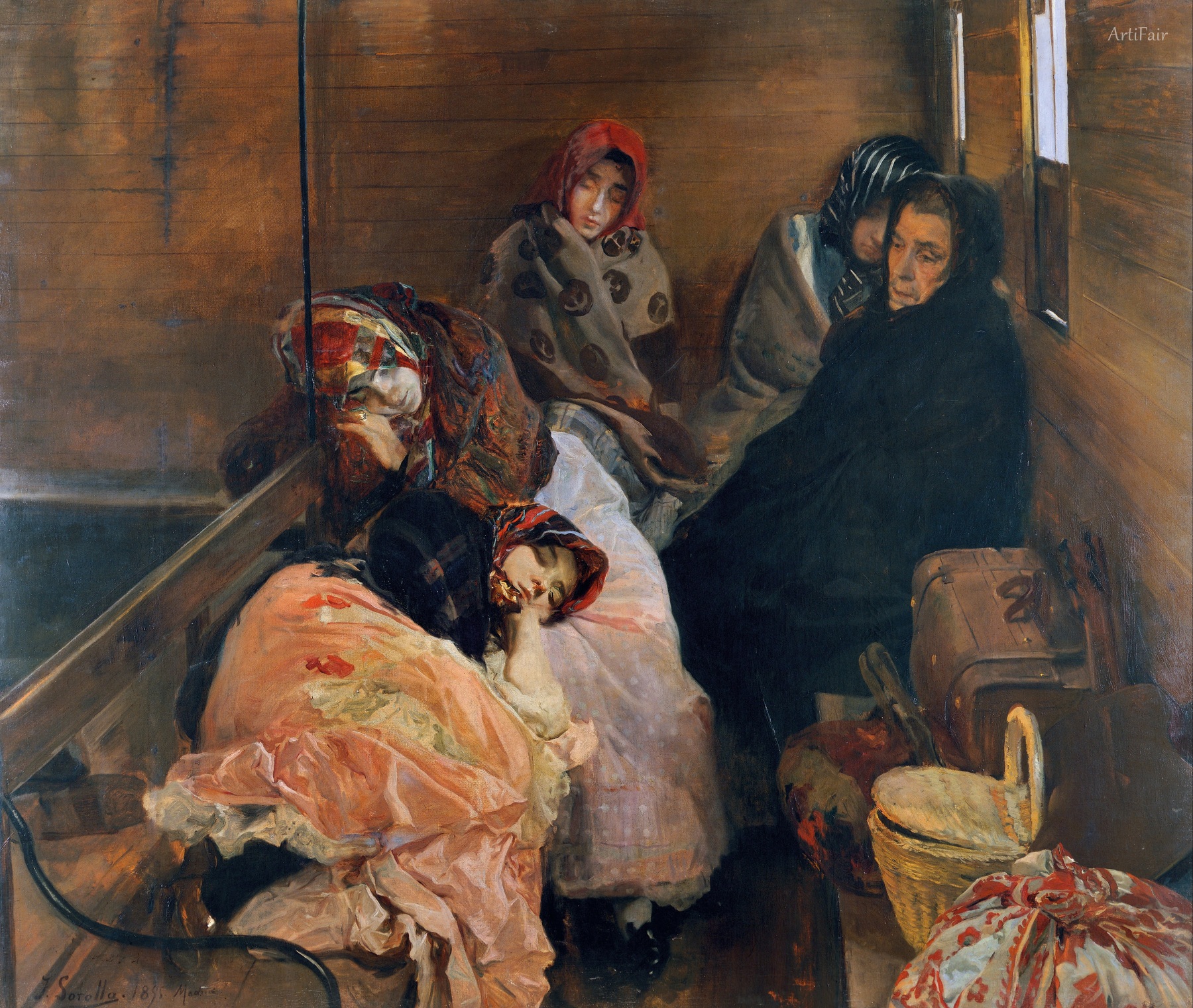
White Slave Trade (Trata de blancas) is an oil on canvas, 166.5 × 195 cm, by Joaquín Sorolla, painted in 1894 and signed again in 1895, showing young women being taken by train to a brothel; it is in the Museo Sorolla, Madrid (inv. 320).
The Museo Sorolla describes it as one of the few examples it holds of the social realism Sorolla practised between 1890 and 1899. The trend had arrived from elsewhere in Europe, focused on the harshest circumstances of the poor, and was common at the Salons of the day, where a narrative subject was still expected. Sorolla painted it in his Madrid studio. In a letter of November 1894 to his friend Pedro Gil he called it the 'wagon' picture, said he would paint it in December, and planned to send it to the Paris Salon of 1895 together with The Return from Fishing. For that Salon the canvas, originally taller, was cut down at the bottom and along the left side, and Sorolla signed it a second time.
In the cramped compartment of a third-class carriage, four girls dressed as country women, in shawls and headscarves, doze in different postures, while an older woman in black, the procuress, stays awake and watchful. Bundles of clothes, shawls and swirling skirts catch the light. The museum notes that Sorolla was as concerned with formal problems as with the story: the steeply foreshortened perspective seems to push the compartment out towards the viewer, who feels drawn in even though the sleeping figures ignore him. Spanish Wikipedia reads the narrow space as a symbol of a fate the women cannot escape, with the subject treated discreetly and with compassion.
The painting was shown in Buenos Aires in 1898. Some Catholic critics objected that so gifted a painter had dirtied his brush with the soot of the brothels. It remained with the artist and entered the museum with his widow's founding bequest.