
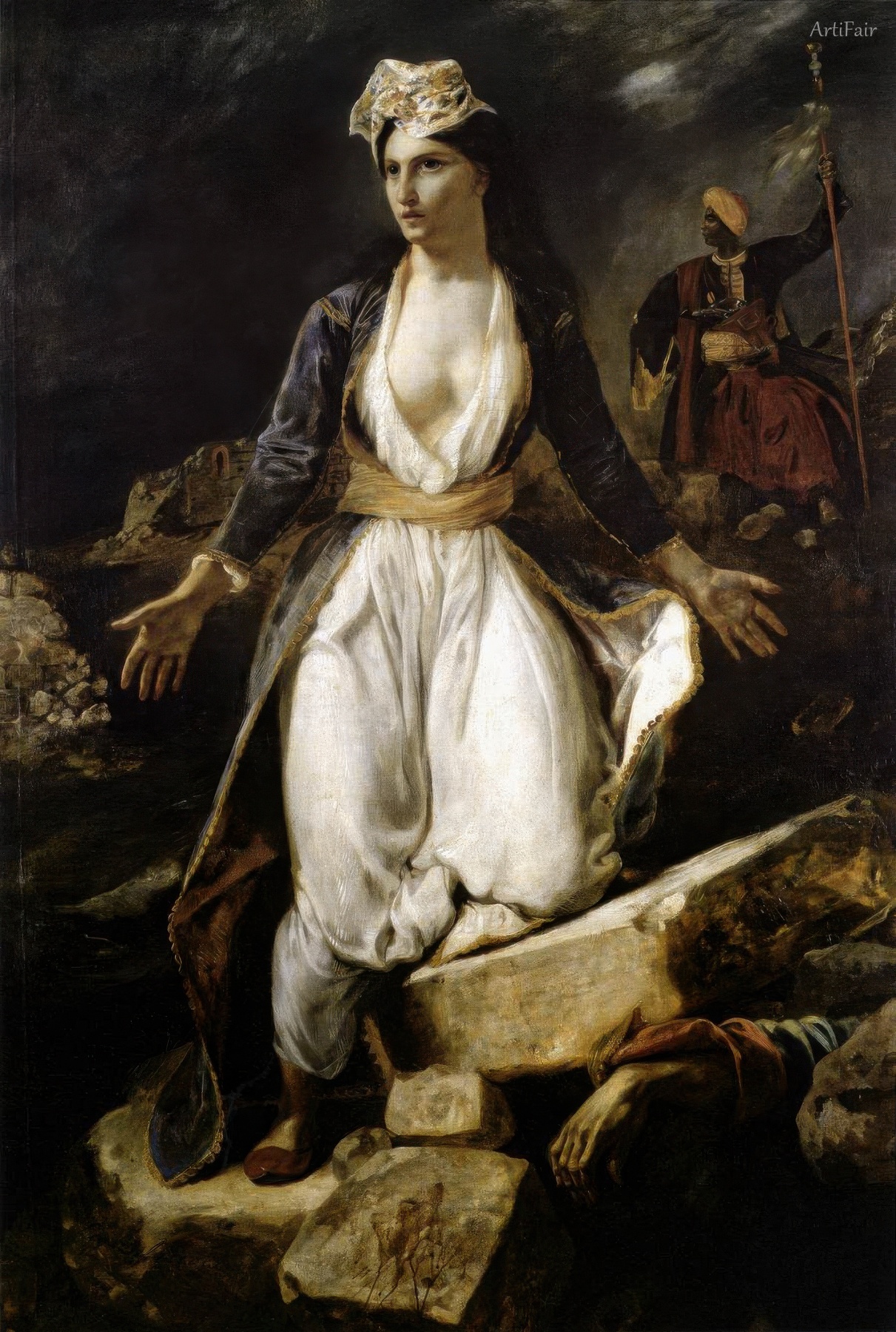
Greece on the Ruins of Missolonghi
Category:
Created:
1826
Likes:
1
Dimensions:
Download:
New users get 4 free credits. 2K costs 1 credit; 4K and Ultra HD are priced by resolution. Public domain artworks can be used commercially.
Dominant colors
Public domain download summary
This artwork is provided as a public domain image resource. The 2K file costs 1 credit for everyday creative work, while 4K and Ultra HD files are priced by resolution.
Art Appreciation
Greece on the Ruins of Missolonghi (La Grèce sur les ruines de Missolonghi) is an oil painting on canvas by Eugène Delacroix, signed and dated 1826 at lower left and held by the Musée des Beaux-Arts de Bordeaux (Bx E 439); it measures 213 × 142 cm.
Missolonghi, on the Gulf of Patras, had become a symbol of the Greek War of Independence against Ottoman rule. Lord Byron died there in 1824, and after a siege of almost a year, worn down by hunger and disease, the town fell in April 1826; its last defenders blew up their own mines, killing Greeks and Turks alike. Delacroix painted his response within months, probably between mid-June and mid-August 1826, two years after his Massacre at Chios, although he had never been to Greece. The canvas was shown that year in Paris at the dealer Lebrun's gallery, in a paid exhibition organised by the Paris Philhellenic Committee, with the proceeds going to the Greek insurgents.
This time Delacroix chose allegory rather than a scene of carnage, a genre that was out of fashion in 1826. Greece is a young woman in national dress, a white gown open at the breast under a dark blue jacket, with a yellow sash. She half-kneels on blood-stained blocks of masonry with her empty hands spread wide; beneath her the arm of a crushed defender reaches out of the rubble. Behind her, against heavy black clouds, a turbaned soldier plants his standard. Her expression is often read as despair, but also as a refusal to give in.
Victor Hugo admired the picture when it was shown at Lebrun's. It was later exhibited in London in 1828 and at the Musée Colbert in Paris in 1829. Bordeaux bought it in 1852 at the Salon of the city's Société des Amis des Arts. The museum regards the allegorical figure and its political charge as a forerunner of Liberty Leading the People of 1830.