
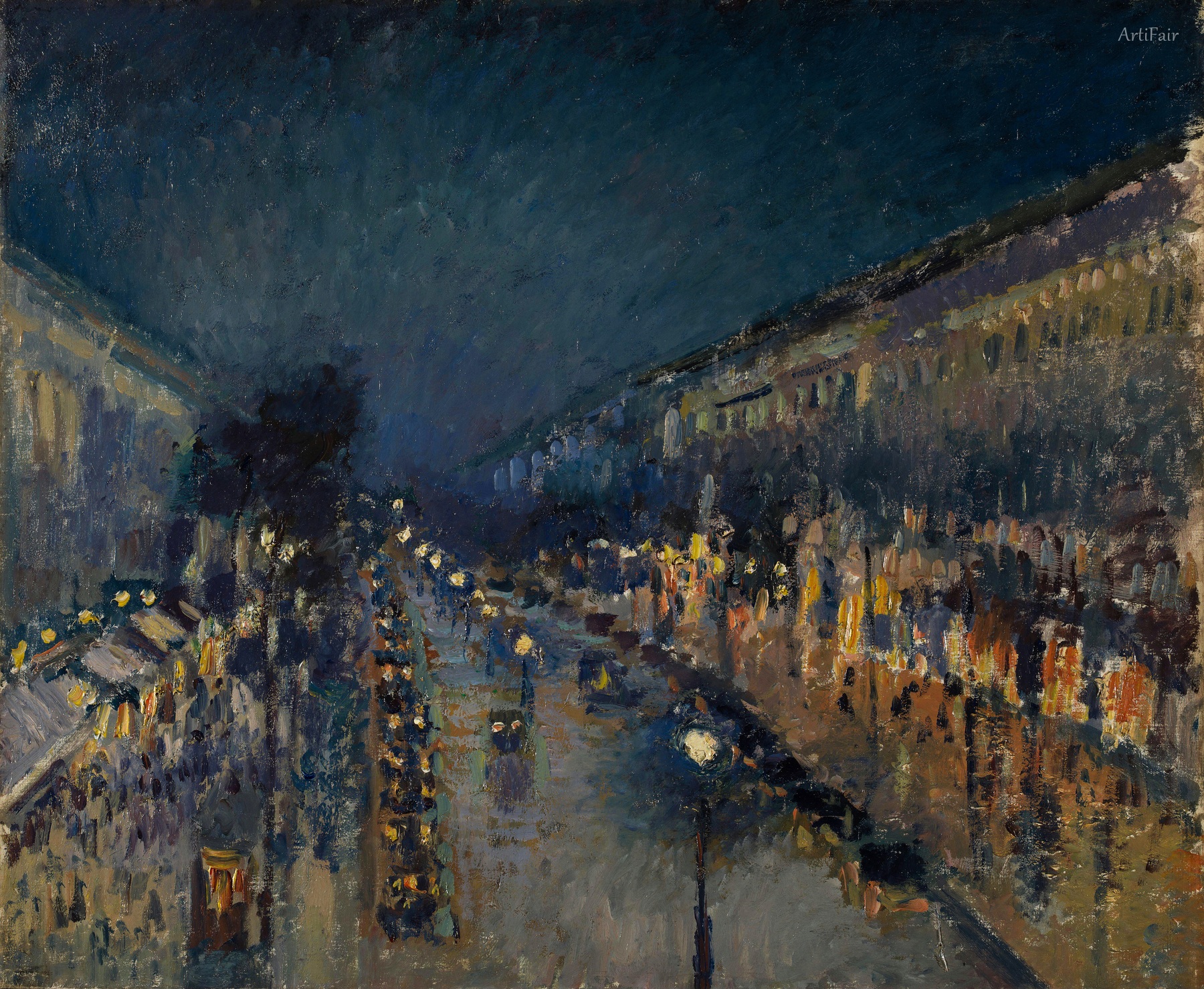
The Boulevard Montmartre at Night
Category:
Created:
1897
Likes:
2
Dimensions:
Download:
New users get 4 free credits. 2K costs 1 credit; 4K and Ultra HD are priced by resolution. Public domain artworks can be used commercially.
Dominant colors
Public domain download summary
This artwork is provided as a public domain image resource. The 2K file costs 1 credit for everyday creative work, while 4K and Ultra HD files are priced by resolution.
Art Appreciation
The Boulevard Montmartre at Night is an oil on canvas painted by Camille Pissarro in 1897, the only night scene among his fourteen views of the Paris boulevard; it is in the National Gallery, London (NG4119).
In February 1897 Pissarro, then in his late sixties and troubled by an eye condition that made outdoor work difficult, took a room at the Grand Hôtel de Russie on the rue Drouot. From its window he could see the Boulevard Montmartre to his left. Writing to his son Lucien on 8 February, he reported that the dealer Paul Durand-Ruel thought a series of the boulevards a good idea. During his stay he painted the street in snow, rain, fog, mist and sunlight, in the morning, the afternoon, at sunset and, once, at night.
The subject posed problems new to a painter best known for daylight country scenes. The whole view is lit artificially: the cool white of the recently installed electric arc lamps running down the centre contrasts with the yellow and orange gaslight of the shop windows and the small red, white and yellow lamps of the cabs lined up along the kerb, all reflected on a pavement still wet from rain. Pissarro had by then abandoned the methodical pointillism he took from Seurat, and here he applied the paint in quick dashes and daubs that suggest crowds and traffic and become almost abstract at close range. Some areas were repainted.
Pissarro neither signed nor exhibited the picture in his lifetime. It came from the collection of his son Lucien Pissarro, was shown at the French Gallery in London in October 1925 and was bought that year through the Courtauld Fund. It hung at the Tate Gallery before being transferred to the National Gallery in 1950.