
The Blind Girl
Category:
Created:
1856
Likes:
1
Dimensions:
Download:
New users get 4 free credits. 2K costs 1 credit; 4K and Ultra HD are priced by resolution. Public domain artworks can be used commercially.
Dominant colors
Public domain download summary
This artwork is provided as a public domain image resource. The 2K file costs 1 credit for everyday creative work, while 4K and Ultra HD files are priced by resolution.
Art Appreciation
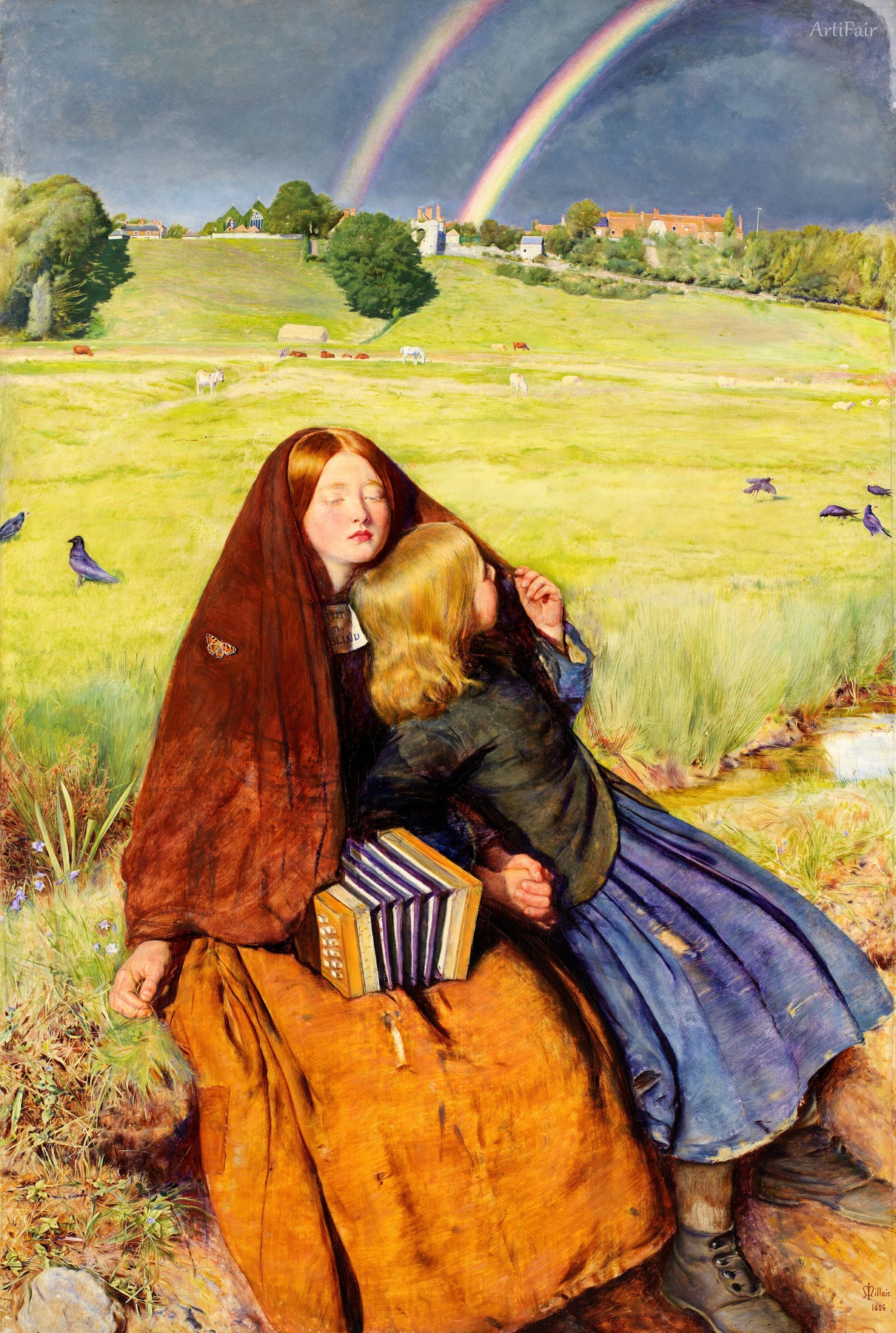
The Blind Girl is an oil painting on canvas by John Everett Millais, signed and dated 1856 and held by Birmingham Museum and Art Gallery, to which the industrialist and politician William Kenrick presented it in 1892.
Millais worked on the picture between 1854 and 1856. According to the museum, he painted the distant landscape, with the Sussex town of Winchelsea on its hill, in the autumn of 1854, and added the two girls the following year in Perth, Scotland. Matilda Proudfoot posed for the blind girl and Isabella Nichol for her younger sister. Millais had first used his wife Effie for the older girl before replacing her; Proudfoot, who was poor but not blind, was found by Effie at a School of Industry in Perth for poor and orphaned children.
The two girls are itinerant beggars resting at the roadside after a storm, apparently on their way to Winchelsea, where the older one, carrying a concertina, might earn money by playing. A label at her neck reads 'Pity the Blind'. The picture is often read as a study of the senses: the blind girl turns her face to the sun and fingers the grass and a small flower, so still that a tortoiseshell butterfly has settled on her shawl, while her sister looks back at a double rainbow she cannot see. Some critics have linked the rainbow to God's covenant after the Flood in Genesis. The museum notes that the scene addresses vagrancy, a social problem of the time, and in particular the plight of children and disabled people.
When the painting was first exhibited in 1856, it was pointed out to Millais that in a double rainbow the colours of the outer bow appear in reverse order. He had painted both bows the same way and corrected the outer one for accuracy. The canvas measures about 83 by 62 cm.