
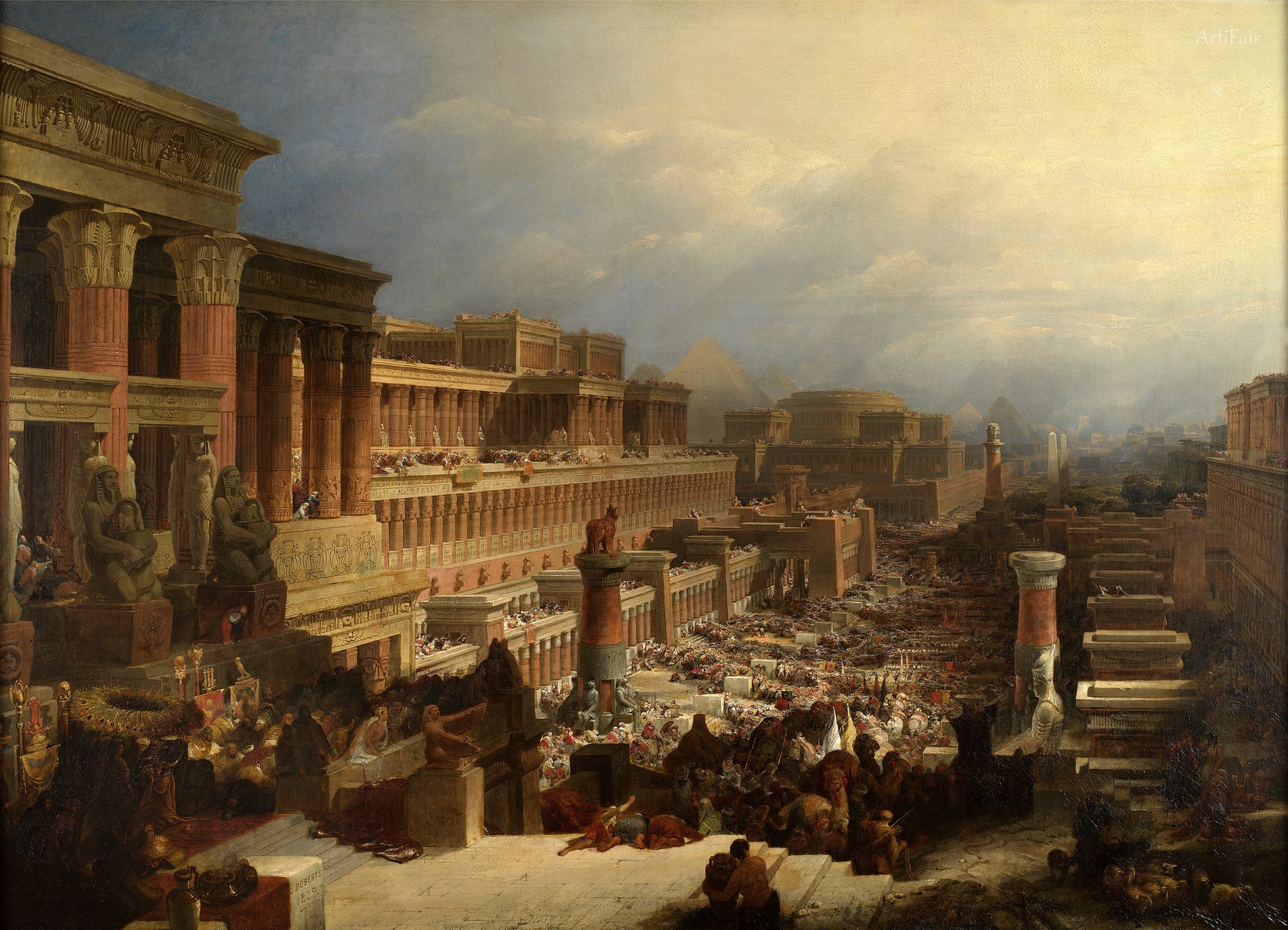
The Israelites Leaving Egypt
Category:
Created:
Date unknown
Likes:
0
Dimensions:
Download:
New users get 4 free credits. 2K costs 1 credit; 4K and Ultra HD are priced by resolution. Public domain artworks can be used commercially.
Dominant colors
Public domain download summary
This artwork is provided as a public domain image resource. The 2K file costs 1 credit for everyday creative work, while 4K and Ultra HD files are priced by resolution.
Art Appreciation
The Israelites Leaving Egypt, also known as The Departure of the Israelites, is a large oil-on-canvas history painting by the Scottish artist David Roberts, exhibited in London in 1829; it is in the Birmingham Museum and Art Gallery, which acquired it in 1986.
Roberts was then best known as a scene painter for the London stage. He had first shown an easel picture in 1824, in the same exhibition as John Martin's Seventh Plague of Egypt, and Martin's huge biblical scenes, packed with towering architecture and tiny figures, had inspired imitators such as Francis Danby, whose Delivery of Israel out of Egypt appeared in 1825. Commissioned by the collector Lord Northwick, an early patron, Roberts's canvas was his first large-scale history painting. Shown at the Society of British Artists in Suffolk Street, it was a breakthrough for him and was reproduced as an engraving.
The subject comes from the Book of Exodus: after the ten plagues, Pharaoh lets the enslaved Israelites go, and Moses leads them out of Egypt towards the Red Sea. Roberts chose no miraculous moment. The viewer looks down, as if from the city walls, onto a broad avenue filled with the departing multitude, carrying flags and banners, while Egyptian onlookers crowd the colonnaded terraces and statues, pillars, porticoes and pyramids fill the scene. Pharaoh is a small seated figure almost lost in the splendour of the foreground, and Moses a shadowed silhouette with upraised arms and rod in the right middle ground. Reviewers dwelt on the masses and the architecture; the Literary Gazette saw a multitude moved by one great impulse.
An article in the journal Nineteenth-Century Art Worldwide argues that Roberts presented the Israelites as a unified modern nation, inviting comparisons between biblical Israel and Britain, while the monumental buildings recalled their slavery at a time when slavery was a pressing political question. Roberts later became known for the views he recorded on his travels in Spain, Italy and above all the Middle East.