
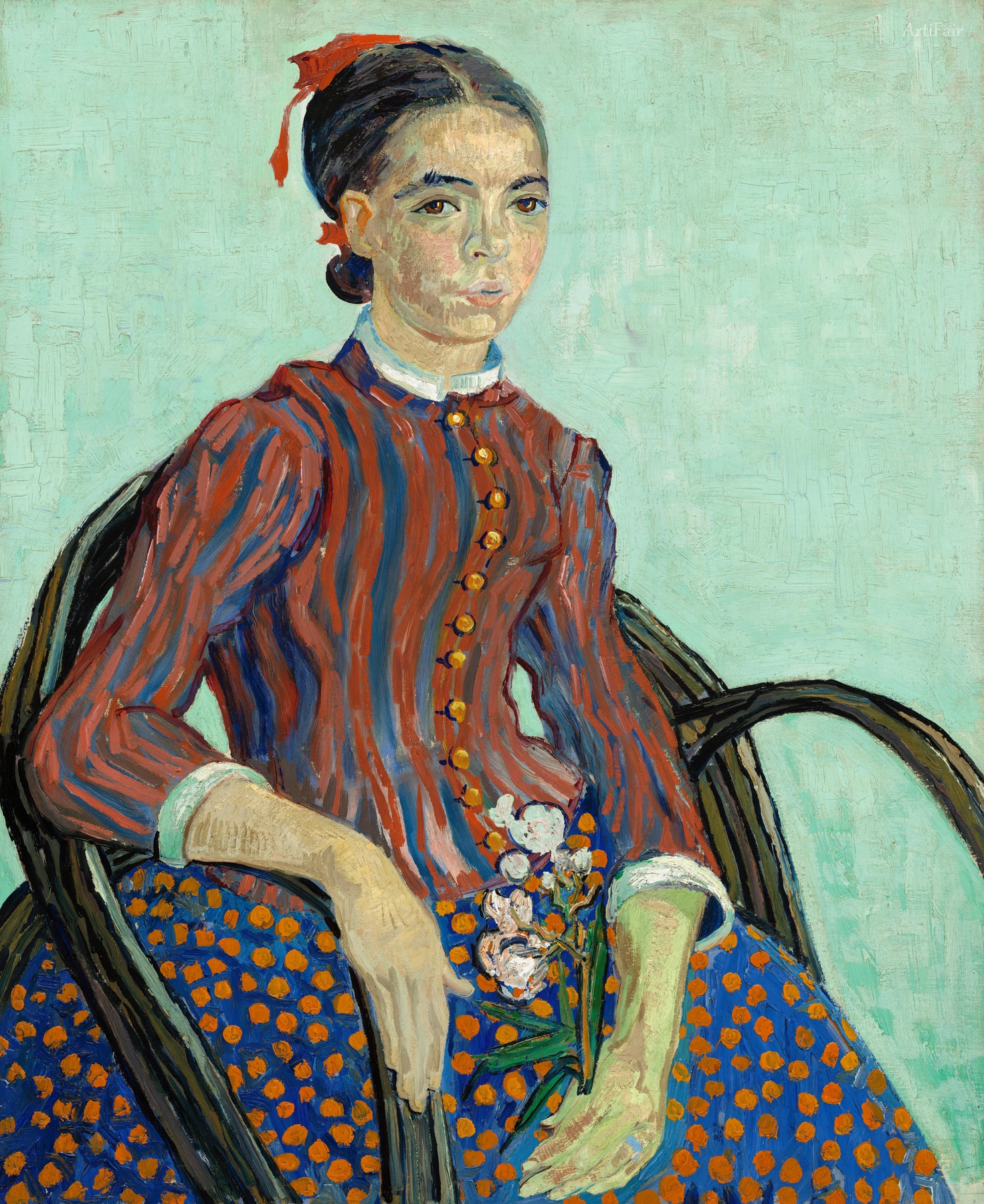
La Mousmé
Category:
Created:
1888
Likes:
0
Dimensions:
Download:
New users get 4 free credits. 2K costs 1 credit; 4K and Ultra HD are priced by resolution. Public domain artworks can be used commercially.
Dominant colors
Public domain download summary
This artwork is provided as a public domain image resource. The 2K file costs 1 credit for everyday creative work, while 4K and Ultra HD files are priced by resolution.
Art Appreciation
La Mousmé is an oil-on-canvas portrait by Vincent van Gogh, painted in Arles in July 1888; it is in the National Gallery of Art, Washington, as part of the Chester Dale Collection.
Van Gogh had moved from Paris to Arles in February 1888, hoping to find in the south something of the clarity of the Japanese prints he admired. The title comes from Pierre Loti's novel Madame Chrysanthème, where mousmé is explained as a Japanese word for a young girl. In a letter to Theo written around 29 July he said that, if his brother had read Loti, he would know what a mousmé was, and that he had just painted one: a Japanese girl, Provençal in this case, aged between 12 and 14. The canvas had taken him his whole week; he had been unwell and had to save his mental powers to finish it. Together with the Zouave, it gave him two figure paintings.
The sitter, a local girl, sits in a bentwood cane chair holding a sprig of oleander. Her jacket and skirt set blue against orange, complementary colours that stand out from the pale green ground, which is brushed in a criss-cross pattern. The face is modelled with far more care than the hands. Van Gogh wrote in this period that portraiture was the thing in painting that most made him feel the infinite. He also made three drawings after the oil, sent to Emile Bernard, John Peter Russell and Paul Gauguin; they are now in the Pushkin Museum, a London collection and the Louvre.
The canvas measures 73.3 × 60.3 cm. Van Gogh sent it to Theo in Paris that summer, and Camille Pissarro saw it there in September. Jo van Gogh-Bonger lent it to the 1905 retrospective at the Stedelijk Museum in Amsterdam and sold it in 1909; it then belonged to the playwright Carl Sternheim, to collectors in Paris and Oslo, and from 1929 to Chester Dale of New York, whose bequest brought it to the National Gallery in 1963. In the early 1930s it was exhibited in New York and Chicago under the mistaken title Mademoiselle Gachet.