
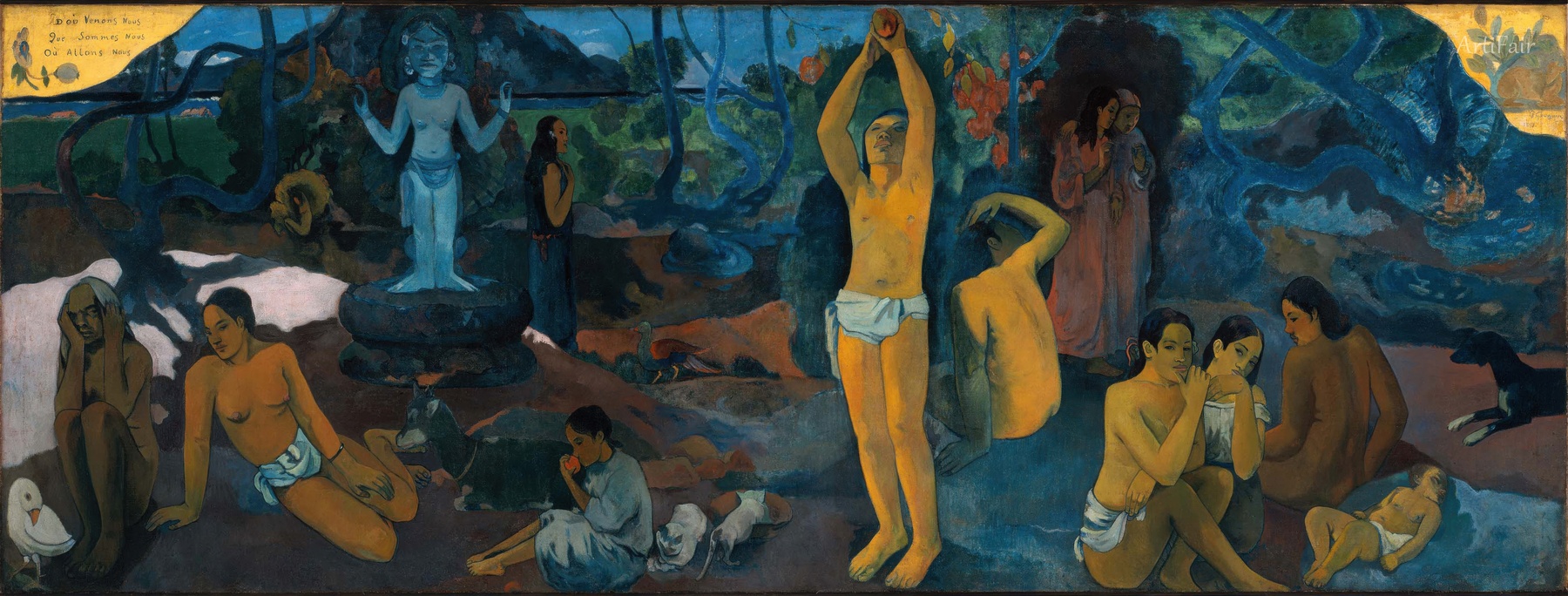
Where Do We Come From? What Are We? Where Are We Going?
Category:
Created:
1897
Likes:
0
Dimensions:
Download:
New users get 4 free credits. 2K costs 1 credit; 4K and Ultra HD are priced by resolution. Public domain artworks can be used commercially.
Dominant colors
Public domain download summary
This artwork is provided as a public domain image resource. The 2K file costs 1 credit for everyday creative work, while 4K and Ultra HD files are priced by resolution.
Art Appreciation
Where Do We Come From? What Are We? Where Are We Going? (D'où venons-nous ? Que sommes-nous ? Où allons-nous ?) is an oil painting on coarse burlap by Paul Gauguin, made in Tahiti in 1897–98 and held by the Museum of Fine Arts, Boston; at 139.1 × 374.6 cm it is the largest picture he ever attempted.
Gauguin had gone to Tahiti in 1891 looking for a simpler society than that of France, and returned there in 1895. By the winter of 1897 he was in crisis: ill with eczema, syphilis and conjunctivitis, in debt, at odds with the colonial authorities, and grieving the news that his daughter had died. In a letter to his friend Daniel de Monfreid he said he planned to kill himself in December 1897, but first wanted to paint a large canvas summing up his thought. After finishing it he attempted suicide with arsenic. The questions of the title may echo the catechism of Bishop Dupanloup, whose lessons Gauguin had followed as a boy at the seminary near Orléans.
Gauguin explained that the picture should be read from right to left. It begins with a sleeping infant and three crouching women, passes through a central figure reaching for fruit, recalling Eve, and ends with an old woman nearing death, beside whom a strange white bird stands for the uselessness of vain words. A blue idol with raised arms, he wrote, indicates the Beyond. He wanted the work to look like a mural, with yellow corners like a fresco spoiled by age attached to a golden wall: the upper left carries the title, without question marks, and the upper right his signature and the date 1897.
In 1898 Gauguin sent the canvas to Monfreid in Paris, and Ambroise Vollard exhibited it with eight related works from 17 November to 10 December that year. Critics were puzzled; André Fontainas compared it to Puvis de Chavannes, prompting Gauguin to insist that his painting spoke a language of feelings that words could not convey. Gabriel Frizeau bought it in 1901 for 2,500 francs. It later belonged to the Norwegian shipowner Jørgen Breder Stang, and the Boston museum acquired it from the Marie Harriman Gallery on 16 April 1936.