
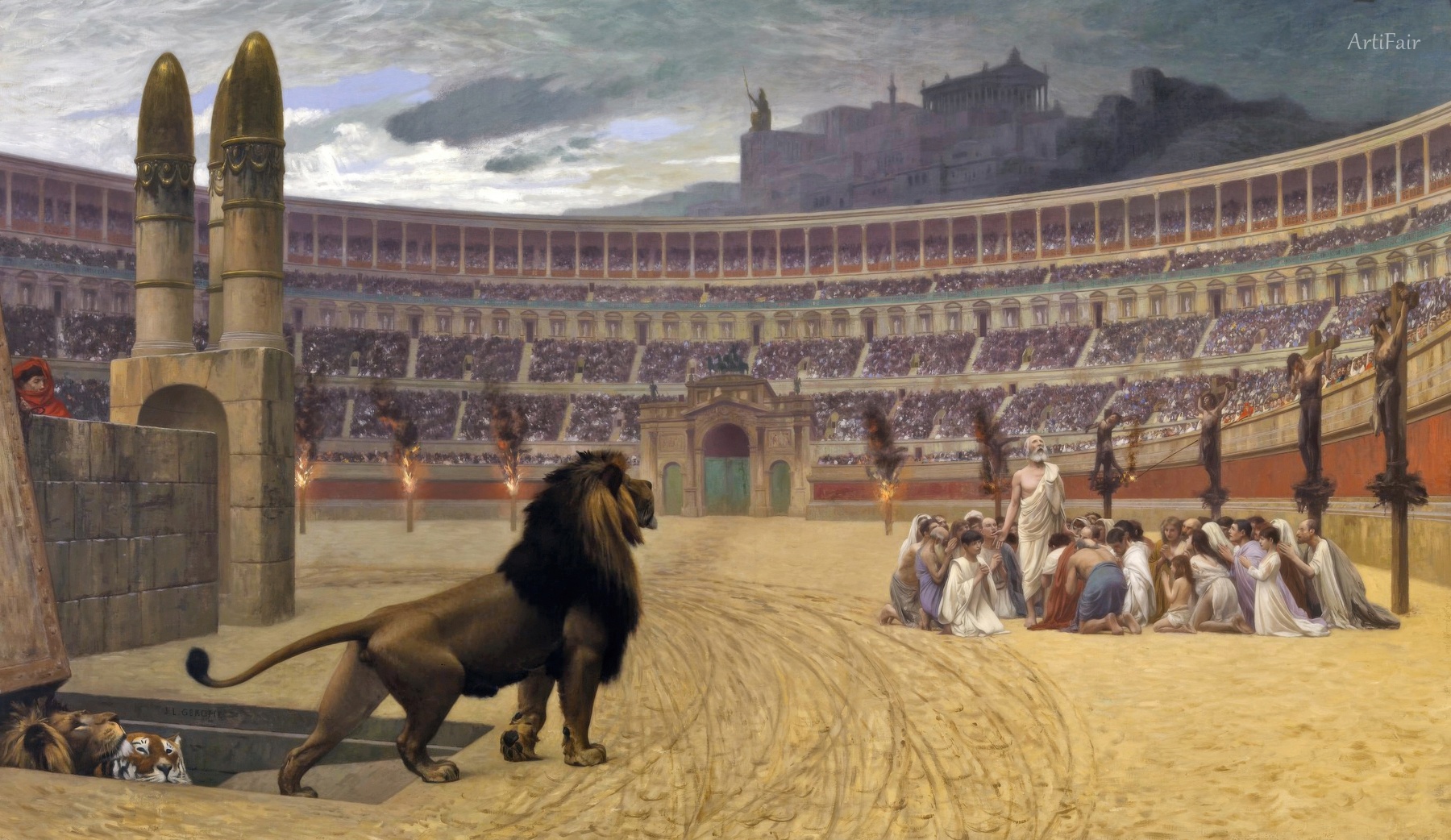
The Christian Martyrs' Last Prayer
Category:
Created:
1883
Likes:
0
Dimensions:
Download:
New users get 4 free credits. 2K costs 1 credit; 4K and Ultra HD are priced by resolution. Public domain artworks can be used commercially.
Dominant colors
Public domain download summary
This artwork is provided as a public domain image resource. The 2K file costs 1 credit for everyday creative work, while 4K and Ultra HD files are priced by resolution.
Art Appreciation
The Christian Martyrs' Last Prayer (La Dernière Prière des martyrs chrétiens) is an oil painting on canvas by Jean-Léon Gérôme, commissioned in 1863 and completed in 1883, and now in the Walters Art Museum, Baltimore (37.113).
The Baltimore collector William T. Walters ordered the picture in 1863, but Gérôme delivered it only twenty years later, through Walters's Paris agent George A. Lucas. In the letter that accompanied the canvas, Gérôme apologised for the delay: the subject had been on his easel for more than twenty years, he had repainted it from the beginning three times, and what Walters was receiving was in effect the third canvas. He called it one of his most studied works and ended by asking whether it was a success.
Gérôme set the scene in the Circus Maximus, pointing in his letter to the turning posts at the end of the spina and the chariot tracks in the sand. A group of Christians, men, women and children, kneel in prayer around an old man who looks up with open palms, while a lion steps out of an underground passage and halts, startled by the light and the crowd, the moment Gérôme said he wanted to show. Around the arena other victims, smeared with pitch, hang on crosses that are being set alight. The Walters notes that the seating resembles the Colosseum, the hill with its temple and colossal statue looks more like the Athenian Acropolis than the Palatine, and such executions never took place in the Circus Maximus: here drama outweighs historical accuracy. The canvas measures 87.9 × 150.1 cm and is signed at the left.
After William Walters died in 1894 the painting passed to his son Henry, who bequeathed it with his collection to Baltimore in 1931. Its staging has been linked to later cinema, including the Italian film Nero of 1909 and Cecil B. DeMille's The Sign of the Cross of 1932.