
The Picnic
Category:
Created:
1887
Likes:
0
Dimensions:
Download:
New users get 4 free credits. 2K costs 1 credit; 4K and Ultra HD are priced by resolution. Public domain artworks can be used commercially.
Dominant colors
Public domain download summary
This artwork is provided as a public domain image resource. The 2K file costs 1 credit for everyday creative work, while 4K and Ultra HD files are priced by resolution.
Art Appreciation
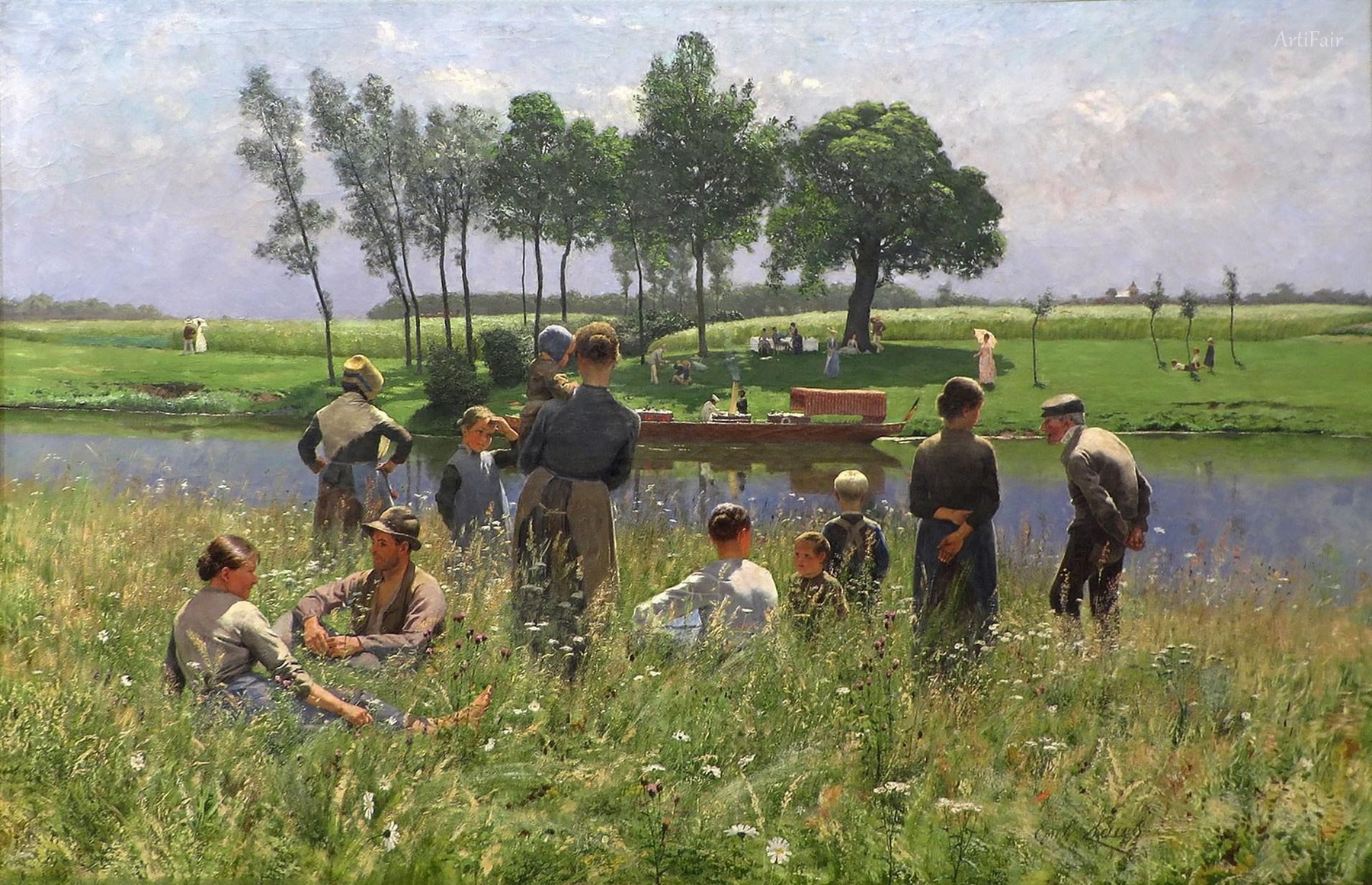
The Picnic (Le Pique-nique, also listed as Picknick – Landschap aan de Leie) is an oil painting on canvas by the Belgian painter Emile Claus, made around 1886–1887; it measures 129 × 198 cm and belongs to the Royal Collection of Belgium (inv. 885), kept in Brussels.
Claus, born in 1849 at Sint-Eloois-Vijve on the river Lys and trained at the Antwerp Academy, moved in 1883 to a country house at Astene near Deinze with a view over the same river, and married in 1886. The Lys became a recurring subject of his work, and The Picnic is one of the first large canvases built around it. In style it still belongs to the monumental naturalism, indebted to Jules Bastien-Lepage, that had brought him success, although through his friend Camille Lemonnier he was already looking at French Impressionism. Sotheby's has described the composition as the culmination of ideas first tried in his river scene Le Bateau qui passe of 1883.
The canvas is split into two bands by the water. In the tall grass and wild flowers of the near bank sits and stands a group of country people, eleven carefully worked figures of all ages; only two of them look across. On the mown far bank, well-to-do townspeople from Ghent are enjoying a Sunday outing: servants prepare food on a boat, guests sit at a white table in the shade, and others lounge or stroll. These figures are smaller and more sketchily painted, and three farm children watch them from the right. The choice of viewpoint places the painter on the side of the rural onlookers, but the picture contrasts two social worlds without open protest.
Claus sent the painting to the triennial Brussels Salon of 1887. The Belgian government wanted it for the Royal Museum of Fine Arts in Antwerp, but King Leopold II moved first and bought it in 1888. It has been lent to exhibitions in Ostend (1997), Ghent (2009) and Giverny (2014).