
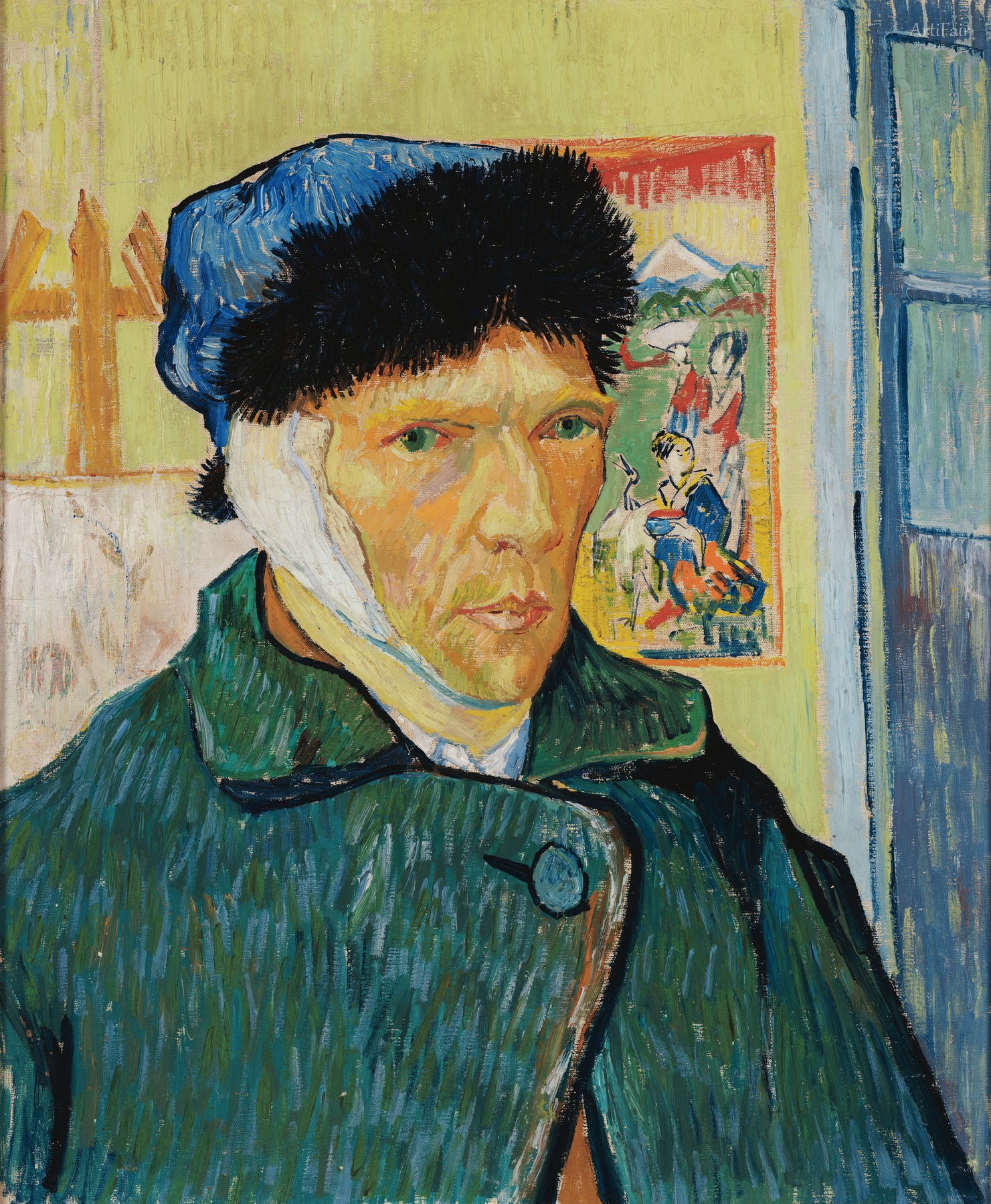
Self-Portrait with Bandaged Ear
Category:
Created:
1889
Likes:
0
Dimensions:
Download:
New users get 4 free credits. 2K costs 1 credit; 4K and Ultra HD are priced by resolution. Public domain artworks can be used commercially.
Dominant colors
Public domain download summary
This artwork is provided as a public domain image resource. The 2K file costs 1 credit for everyday creative work, while 4K and Ultra HD files are priced by resolution.
Art Appreciation
Self-Portrait with Bandaged Ear is an oil-on-canvas painting by Vincent van Gogh, made in Arles in January 1889, about a week after he left hospital; it is in the Courtauld Gallery at Somerset House, London.
Van Gogh had moved to Arles hoping to found a Studio of the South, where like-minded artists would work side by side, and Paul Gauguin joined him at the Yellow House in October 1888. On the evening of 23 December, after a violent quarrel with Gauguin, he cut off most of his left ear with a razor. He was treated in the Arles hospital until 7 January 1889, and came home to find Gauguin gone and with him the plan for a shared studio. In mid-January he painted two self-portraits with the bandaged wound; this is one of them, and in a letter to Theo of 17 January he mentioned a new self-portrait, thought to be this canvas. Because he painted from a mirror, the bandage appears on the right side of his face.
He shows himself in a green overcoat and a fur cap, recently bought to hold the heavy bandage in place and keep out the winter cold. Behind him are a canvas on an easel, only just begun, and a Japanese woodblock print, a freely adapted version of Geishas in a Landscape by Satō Torakiyo from the 1870s, which Van Gogh owned. The Courtauld reads these objects as signs of his determination to go on painting and of the importance of Japanese art to him, while the thick impasto reflects his admiration for Adolphe Monticelli's handling of paint.
The canvas measures 60.5 × 50 cm. At Van Gogh's death it was with the Paris colour merchant Julien Tanguy, who had sat for him twice in 1887. It was shown in Paris in 1901 and in a large retrospective in 1905, and in 1928 the industrialist and collector Samuel Courtauld bought it; his collection later passed to the institute that bears his name.