
Ashes
Category:
Created:
1895
Likes:
0
Dimensions:
Download:
New users get 4 free credits. 2K costs 1 credit; 4K and Ultra HD are priced by resolution. Public domain artworks can be used commercially.
Dominant colors
Public domain download summary
This artwork is provided as a public domain image resource. The 2K file costs 1 credit for everyday creative work, while 4K and Ultra HD files are priced by resolution.
Art Appreciation
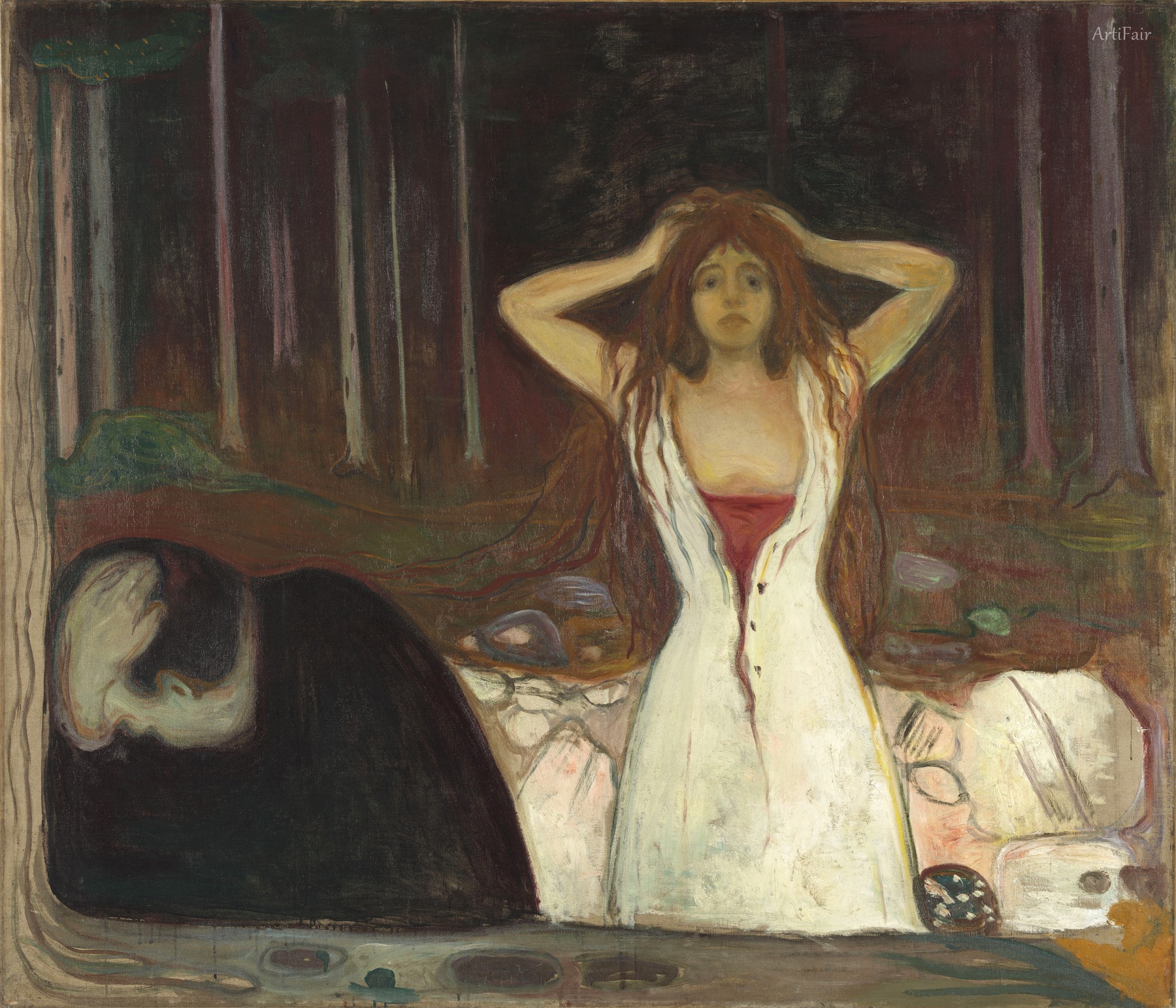
Ashes (Aske) is an oil painting on canvas by Edvard Munch, now dated to 1895 and held by the National Museum of Art, Architecture and Design in Oslo (NG.M.00809); it measures 120.5 × 141 cm and is signed E. Munch at upper right.
For a long time the picture was dated 1894, but the National Museum now places it in 1895, partly on the evidence of a letter of September that year mentioning a new Munch painting called Adam and Eve after the Fall. When it was shown at the big Frieze of Life exhibition in Berlin in 1902 it was listed as After the Fall, and it opened the group of paintings on the main wall, devoted to love's flowering and decline. A forest interior of 1893 is regarded as a preliminary study, and the two were exhibited together at Blomqvist in Kristiania in the autumn of 1895.
In front of a dark wall of slender trunks, a woman in a pale dress with an open bodice and red undergarment faces the viewer, hands pressed to her head and hair loose. In the lower left corner a man in black crouches with his back to her, his face ashen. A stylised fallen trunk frames the pair. Munch wrote on a lithograph of the motif that he felt their love lying on the ground like a heap of ashes, which explains both the title and the trunk. The museum calls it possibly his most pessimistic image of relations between the sexes, with the man weak and defeated and the woman strong; writers have also linked it to Munch's secret affair with Milly Thaulow, who was married to his cousin.
The National Gallery bought the painting in 1909 with funds from the A. C. Houen Endowment. Munch made lithographs of the subject in 1896 and 1899, and in January 1925 he registered at the gallery to copy it; the resulting second version, with stronger colour, is in the Munch Museum.