
Ulysses and the Sirens
Category:
Created:
1891
Likes:
1
Dimensions:
Download:
New users get 4 free credits. 2K costs 1 credit; 4K and Ultra HD are priced by resolution. Public domain artworks can be used commercially.
Dominant colors
Public domain download summary
This artwork is provided as a public domain image resource. The 2K file costs 1 credit for everyday creative work, while 4K and Ultra HD files are priced by resolution.
Art Appreciation
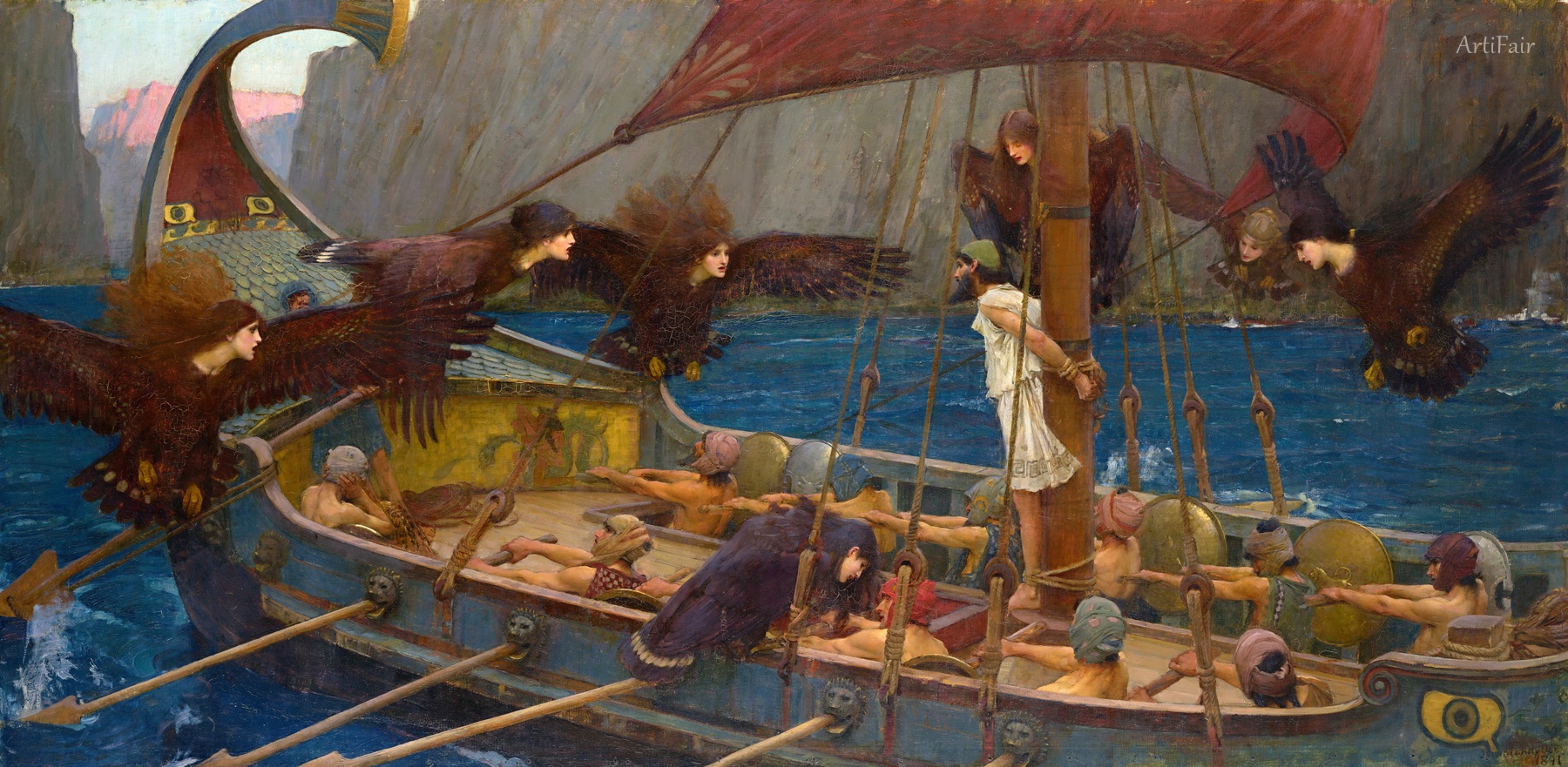
Ulysses and the Sirens is an oil painting on canvas by John William Waterhouse, completed in 1891 and held by the National Gallery of Victoria, Melbourne.
The subject is the episode in Book XII of Homer's Odyssey in which Ulysses, warned by Circe, sails past the island of the Sirens, whose song lures sailors to their deaths. He stops his crew's ears with wax and has himself bound to the mast so that he can hear the song without steering to destruction. Waterhouse shows the ship in a narrow, rocky strait: the oarsmen pull hard, Ulysses strains against his ropes, and the Sirens circle and perch on the rigging as large birds with the heads of women.
That choice of form was the picture's most debated feature. Victorian viewers were used to Sirens as graceful, mermaid-like women, and Waterhouse instead followed ancient imagery, most likely a Greek stamnos of the fifth century BC in the British Museum. Shown at the Royal Academy in 1891, the canvas drew mostly favourable reviews. M. H. Spielmann of the Magazine of Art noted that classical vases supported the bird-women and called the work a startling triumph and a carnival of colour; the Saturday Review observed that Waterhouse had painted seven Sirens where Homer has two. The Times was harsher, objecting that the creatures looked more like harpies and failed to suggest an enchanting song.
In June 1891 Sir Hubert von Herkomer, the gallery's London adviser, bought the painting for Melbourne for £1200; it was only the second Waterhouse to enter a public collection. Its arrival late that year set off a press controversy in Melbourne over the price, the power given to a single adviser, a perceived preference for foreign over local art, and the painter's free handling of Homer. The canvas measures 100.6 by 202.0 cm and has remained at the gallery ever since. Christopher Wood later called it the most outstanding of all Victorian pictures based on Homer.